EIN vs ITIN vs SSN: What's the Difference?
A Guide for International Entrepreneurs
If you're starting a U.S. business as an international entrepreneur, you'll probably encounter three abbreviations very quickly:
EIN. ITIN. SSN.
And that's usually when the questions begin.
Which one do I need?
Can I use my ITIN instead of an EIN?
Do I need an SSN to own a U.S. company?
Does having an EIN allow me to work in the United States?
The easiest way to understand these numbers is to stop thinking of them as alternatives.
EIN, ITIN, and SSN identify different things and serve different purposes.
Let's break down the difference.
1. EIN — The Business Identification Number
EIN stands for Employer Identification Number. An EIN is a federal tax identification number used to identify a business entity. Think of it this way:
Your company has an identity. The EIN is one of the key numbers used to identify that company for federal tax and business purposes.
Depending on the circumstances, businesses may need an EIN for employment taxes, tax filings, banking, state tax purposes, and other business processes.
For an international entrepreneur establishing a U.S. business, the EIN often becomes an important part of setting up the company's operations.
It may be relevant for:
Business banking
Federal tax filings
Payroll
Business documentation
Certain financial and compliance processes
The most important thing to remember is:
An EIN generally belongs to the business—not to you personally.
2. SSN — Your Personal Social Security Number
An SSN, or Social Security Number, is a nine-digit number issued by the Social Security Administration. Unlike an EIN, an SSN identifies an individual, not a business. For individuals who are legally eligible for one, an SSN can be used for individual tax and employment-related purposes. For international entrepreneurs, there's an important distinction:
Owning a U.S. company does not automatically mean you have—or need to qualify for—an SSN. Business ownership and an individual's eligibility for an SSN are separate questions.
3. ITIN — An Individual Tax Number for Certain People Without an SSN
ITIN stands for Individual Taxpayer Identification Number. Unlike an SSN, an ITIN is issued by the IRS. It is intended for certain individuals who need a U.S. taxpayer identification number for federal tax purposes but aren't eligible for an SSN. For example, a nonresident alien who has a U.S. federal tax filing requirement may need an ITIN if they aren't eligible for an SSN.
But there's a critical limitation:
An ITIN is for federal tax purposes.
It does not provide U.S. work authorization or change someone's immigration status. And it shouldn't be viewed as a universal replacement for an SSN.
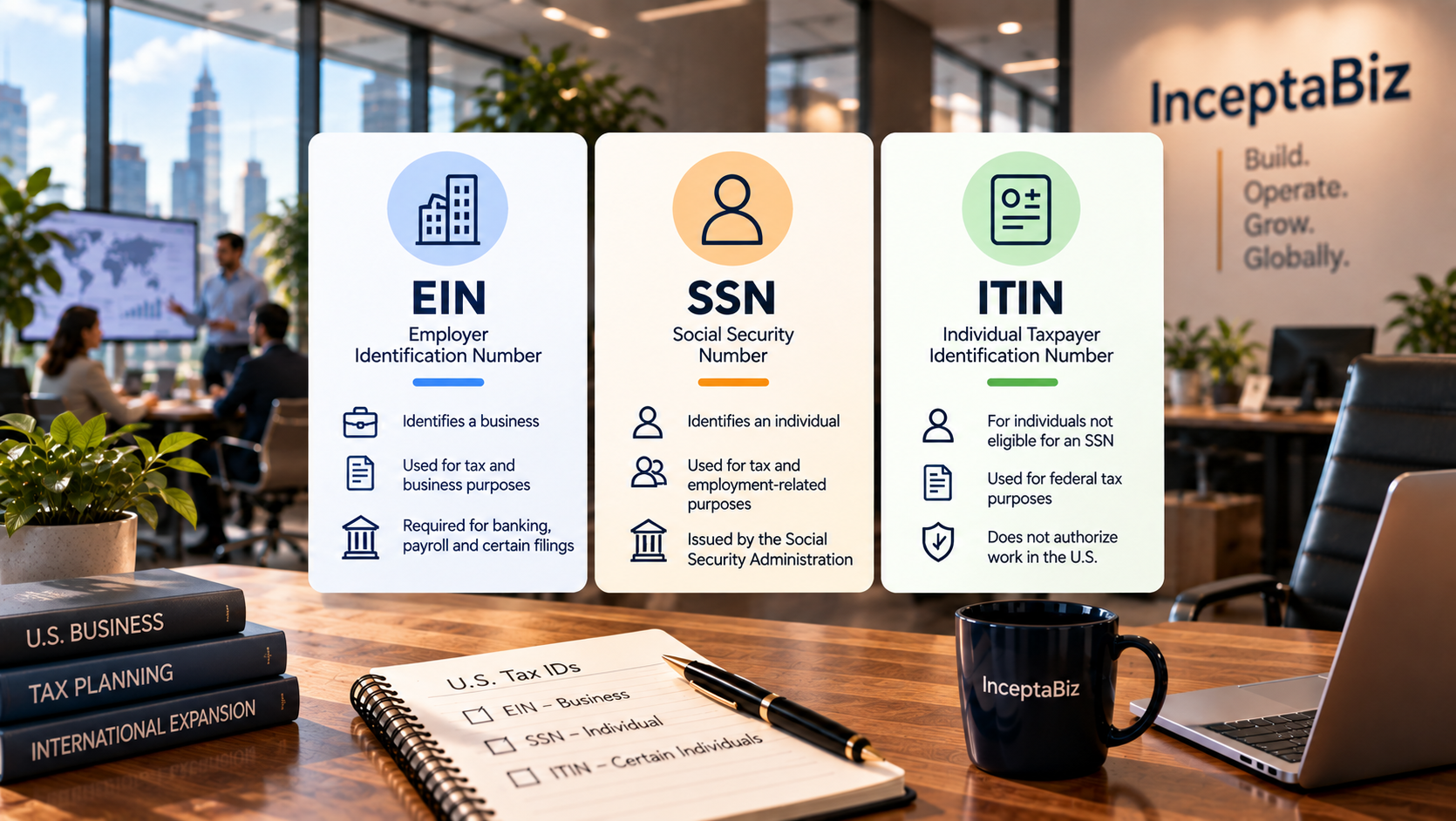
EIN vs ITIN vs SSN: The Simple Difference
Here's the easiest way to remember them:
Number
Generally Identifies
Primary Context
EIN
Business
Federal tax/business identification
SSN
Individual
Social Security, tax and employment-related identification
ITIN
Individual
Federal tax identification for certain people not eligible for an SSN. Or even more simply:
EIN → Business
SSN → Individual
ITIN → Individual who needs a federal tax ID but isn't eligible for an SSN
Once you understand that distinction, much of the confusion disappears.
A Real-World Example
Imagine Alex lives outside the United States and forms a U.S. LLC. Alex doesn't have an SSN.
Should Alex immediately apply for an ITIN?
Not necessarily.
The better question is:
“What does my business need, and what do I personally need for U.S. tax purposes?”
The business may need an EIN.
Alex personally may or may not need an ITIN, depending on the actual U.S. federal tax situation. And if Alex isn't eligible for an SSN, that doesn't mean an ITIN simply becomes a substitute for one. This distinction between the business and the individual is essential.
Two Common Misconceptions
“I need an SSN to start a U.S. company.”
That's too broad. Business formation, business tax identification, and an individual's Social Security eligibility are separate questions.
“My ITIN is my company's tax number.”
It isn't.
An ITIN identifies an individual for certain federal tax purposes. An EIN identifies a business or other qualifying entity for federal tax purposes.
Jimmy's Insight
“Don't ask which number is better. Ask: Who does this number belong to, and what is it being used for?”
— Jimmy Flores, Senior Tax & Business Strategist
EIN, ITIN, and SSN aren't three versions of the same identification number. They serve different purposes.
Before You Apply for Anything
One of the biggest mistakes entrepreneurs make is applying for an identification number before understanding why they need it. Instead, ask three questions:
1. Who needs the number?
Me personally—or my business?
2. Why is it needed?
Tax filing, business operations, employment, banking, or another requirement?
3. Am I eligible for it?
This is particularly important when considering SSN and ITIN eligibility.
Understand the requirement first. Then apply for the appropriate identification number.
Know Which Number Belongs to Whom
The most important takeaway is simple:
EIN = Business
SSN = Individual
ITIN = Certain individuals who need a U.S. federal tax identification number but aren't eligible for an SSN
Having one doesn't automatically mean you need—or qualify for—the others. Your company's requirements and your personal tax situation should be considered separately.
At InceptaBiz, we help international entrepreneurs navigate the U.S. business setup process, including company formation, EIN processes, individual tax identification considerations, banking, bookkeeping, tax compliance, and ongoing business support.
The right tax ID isn't about having more numbers. It's about knowing which number belongs to you—and why.