Opening a U.S. business bank account is an important step. But once the account is open, another question quickly appears:
How should money actually move in and out of the business?
A customer wants to pay you. You need to pay a contractor. Payroll is due. An international supplier sends payment instructions. Suddenly, you're dealing with terms like ACH, Direct Deposit, Wire Transfer, routing number, and account number.
They may sound similar, but they don't all mean the same thing. Understanding how these payment methods work—and when each one makes sense—is an important part of building a professional financial operation.
What Is ACH?
ACH stands for Automated Clearing House.
It is an electronic payment network used to move money between banks and credit unions in the United States.
Businesses commonly use ACH to:
Receive customer payments
Pay vendors and contractors
Make recurring payments
Move money between eligible accounts
Support payroll processes
Think of ACH as the network behind many everyday electronic bank transactions. However, ACH isn't necessarily instant. Processing times can vary depending on the transaction and financial institution, although Same Day ACH may be available for eligible transactions.
So when a customer says:
“We'll pay you by ACH.”
A useful next question is:
“When should I expect the funds to arrive?”
What Is Direct Deposit?
Direct Deposit is where many new business owners become confused. It isn't a completely separate payment network from ACH. Instead, Direct Deposit is a common way the ACH Network is used to deposit money directly into someone's bank account.
Payroll is probably the most familiar example. Instead of giving an employee a paper check, the company electronically sends the employee's pay directly to their bank account. Businesses may also use Direct Deposit for certain reimbursements, bonuses, commissions, and other payments.
The easiest way to remember the relationship is:
ACH = the payment network.
Direct Deposit = one common way that network is used to deliver money.
This distinction becomes especially useful as your company grows and begins hiring employees or establishing more formal payroll processes.
What Is a Wire Transfer?
A Wire Transfer is another method of electronically moving money from one bank account to another. Wire transfers can be domestic or international.
Businesses may use wires for:
Large business payments
Certain time-sensitive transactions
Funding an account
Paying international suppliers
Sending money internationally
Receiving international business payments
But there's an important distinction: A Wire Transfer isn't simply “faster ACH.” It's a different payment method. Banks may have different requirements, fees, transaction limits, and processing procedures for wires. That's why the right question isn't necessarily:
“Which payment method is fastest?”
A better question is:
“Which payment method fits this transaction?”
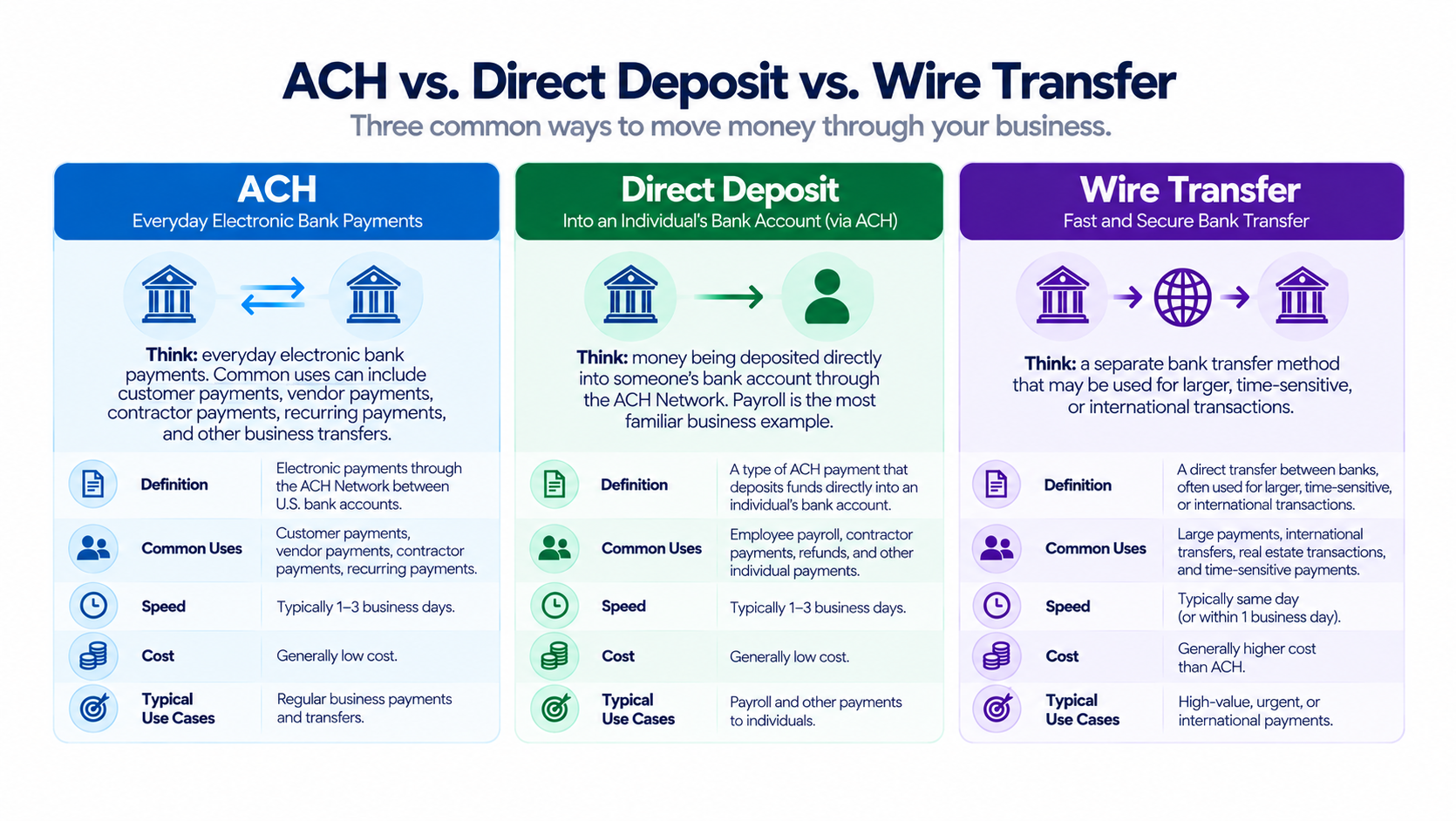
ACH vs. Direct Deposit vs. Wire Transfer
ACH
Think: everyday electronic bank payments. Common uses can include customer payments, vendor payments, contractor payments, recurring payments, and other business transfers.
Direct Deposit
Think: money being deposited directly into someone's bank account through the ACH Network. Payroll is the most familiar business example.
Wire Transfer
Think: a separate bank transfer method that may be used for larger, time-sensitive, or international transactions. The important thing isn't memorizing every banking term. It's understanding how money should move through your business.
One Business Can Use Multiple Payment Methods
Imagine Alex owns a U.S. consulting company. His business has five recurring clients, two contractors, one employee, and an international software supplier. During a normal month, several different payment methods might be appropriate. A client may pay the company through ACH.
The company may also use ACH to pay a contractor, depending on the payment arrangement. Payroll for the employee may be processed through Direct Deposit. And when paying an international supplier, a Wire Transfer may be appropriate depending on the country, bank, amount, and payment requirements. Same company. Same business bank account. Different payment methods. That's the key idea.
Choosing the Right Payment Method
Many entrepreneurs choose a payment method based almost entirely on speed. But faster doesn't automatically mean better. Before deciding how money should move, consider several factors:
Purpose: What is the payment for?
Timing: When does the money need to arrive?
Cost: What fees apply?
Frequency: Is this a one-time payment or a recurring transaction?
Location: Is the payment domestic or international?
Recordkeeping: How will the transaction appear in your financial records?
For example, recurring vendor payments may be well suited to ACH. Payroll may use Direct Deposit. A larger or international transaction may call for a Wire Transfer. The appropriate method depends on the transaction.
Your Payment System Is Part of Your Business System
Moving money isn't only a banking issue. It's also a bookkeeping issue. Imagine your company receives twenty customer payments every month. If those transactions are properly identified and recorded, your bookkeeping becomes much easier to manage. The same principle applies to contractor payments, vendor payments, payroll, refunds, and international transfers.
Every payment creates a financial record. That's why your banking, payment, and bookkeeping systems should work together. A well-organized business doesn't simply know that money moved.
It knows:
Where did the money come from?
Where did it go?
Why did it move?
Protect Your Payment Instructions
Knowing how to send money is important.
Knowing when not to send it can be just as important.
Imagine a supplier suddenly contacts your company and says:
“We've changed our bank account. Please send the next payment to this new account.”
Don't automatically send the money. Significant changes to payment instructions should be verified through a trusted communication channel before initiating the transaction.
A professional payment process includes verification—not just execution.
Five Questions to Ask Before Sending a Business Payment
Before sending or requesting a payment, ask:
1. What is the purpose of this payment?
Are you paying a supplier, contractor, employee, or transferring funds between accounts?
2. Is the payment recurring or one-time?
A recurring monthly payment may have different needs than a one-time transaction.
3. When does the money need to arrive?
Timing can influence which payment method is appropriate.
4. What fees or limits should I expect?
Different payment methods and financial institutions may have different costs and transaction limits.
5. How will this transaction appear in my bookkeeping?
Every payment should eventually make sense within your company's financial records. If you can answer those five questions, you'll have a much better understanding of which payment method to consider.
Build a Payment System, Not Just a Bank Account
Opening a business bank account is only the beginning. As your company grows, you need a financial system that helps you receive, send, track, and understand money effectively.
ACH, Direct Deposit, and Wire Transfers are simply different tools within that system. The goal isn't to find one payment method and use it for everything. The goal is to understand which tool fits which transaction.
At InceptaBiz, we help international founders build the financial infrastructure behind their U.S. businesses—from business banking and payment processes to bookkeeping, tax compliance, and ongoing business support. Because opening the bank account is only the beginning. The real goal is knowing how to use that financial infrastructure as your business grows.
Frequently Asked Questions
Is ACH the same as Direct Deposit?
Not exactly. ACH is the electronic payment network. Direct Deposit is a common way that network is used to deposit money directly into someone's bank account, with payroll being one of the most familiar examples.
Is a Wire Transfer the same as ACH?
No. A Wire Transfer is a different payment method with its own processing procedures, fees, limits, and requirements.
Is ACH always slower than a Wire Transfer?
Not necessarily in every situation. ACH processing times can vary, and Same Day ACH may be available for eligible transactions. The better approach is to consider the timing requirements of the specific payment rather than assuming one method is always best.
Which method should I use to pay employees?
Direct Deposit is a common method for payroll and typically operates through the ACH Network.
Which method should I use for international payments?
Wire Transfers may be used for international business payments, but the appropriate method depends on factors such as the destination country, financial institutions involved, amount, fees, timing, and payment requirements.
Should I use ACH or Wire Transfer for my business?
It depends on the transaction. Consider its purpose, timing, cost, frequency, whether it's domestic or international, and how the payment will be recorded.