Your business is making money. Customers are paying invoices. You're covering expenses, paying contractors, and watching your bank balance grow. Everything seems to be going well. But here's an important question:
Does having money in your business bank account mean your business is actually profitable?
Not necessarily.
Your bank balance tells you how much money is available at a particular moment. It doesn't tell you how much revenue you've earned, which customers still owe you money, what bills are coming due, or whether your business is financially healthy. That's where bookkeeping comes in.
Bookkeeping isn't just about recording transactions. It's about understanding what's really happening inside your business. And for international entrepreneurs operating U.S. companies, having organized financial records is an important part of building a sustainable business.
Your Bank Balance Doesn't Tell the Whole Story
Imagine two entrepreneurs.
Alex has $25,000 in his business bank account.
He checks the balance and feels confident. Business must be going well. But Alex hasn't accounted for several unpaid supplier invoices, an upcoming contractor payment, or a tax-related obligation.
Sarah also has $25,000 in her business bank account. However, she knows exactly how much revenue her company generated, which customer invoices remain unpaid, what expenses are coming due, and what financial obligations need attention.
Both entrepreneurs have the same bank balance.
But Sarah has something Alex doesn't:
Financial clarity.
A bank balance is useful, but it represents only one part of your company's financial picture. Bookkeeping helps connect the pieces.
What Is Bookkeeping?
Bookkeeping is the process of systematically recording, organizing, and maintaining a business's financial transactions.
These transactions can include customer payments, invoices, business expenses, contractor payments, bank transfers, refunds, equipment purchases, loans, and payroll.
A good bookkeeping system helps you answer several important questions:
How much revenue did the business generate?
How much did it spend?
Which customers still owe money?
What bills remain unpaid?
Do the financial records match the bank statements?
Are the records organized for tax preparation?
The goal isn't to create unnecessary paperwork. It's to replace assumptions with reliable financial information.
Five Essential Areas Every Business Should Track
You don't need to become an accountant to understand the fundamentals of bookkeeping. Start with these five areas.
1. Revenue
Revenue represents income your business earns from selling products or providing services. For example, if your consulting company invoices customers for $12,000 during a month, those sales need to be recorded appropriately. But remember: issuing an invoice and receiving payment aren't necessarily the same event. The accounting method used by your business affects when revenue is recognized.
2. Expenses
Expenses are costs associated with operating your business. Common examples include software subscriptions, advertising, professional services, insurance, contractor payments, office supplies, and payment processing fees.
Recording expenses helps you understand where your money goes. It's also important to keep supporting documents, such as receipts and invoices. However, recording an expense doesn't automatically make it tax-deductible. Deductibility depends on the applicable tax rules and circumstances.
3. Accounts Receivable
Accounts receivable generally refers to amounts customers owe your business. Imagine you complete a consulting project and issue a $5,000 invoice. The customer has 30 days to pay. Until the payment arrives, you need a way to track that outstanding invoice. Without this information, you may overlook overdue payments or misunderstand how much cash you expect to receive.
4. Accounts Payable
Accounts payable generally refers to amounts your business owes vendors or suppliers. For example, your company receives a $1,200 invoice for professional services, but the payment isn't due until next month.
That obligation still matters, even though the money hasn't left your bank account. Tracking unpaid bills helps you plan future payments and manage cash flow.
5. Assets, Liabilities, and Equity
As your business grows, you also need to understand its broader financial position. Assets represent resources the business owns or controls. Liabilities represent financial obligations.
Equity generally represents the owners' residual interest in the business after liabilities. These categories are essential components of a balance sheet and help explain your company's financial position beyond its bank balance.
Revenue Is Not the Same as Profit
One of the most important bookkeeping concepts is understanding the difference between revenue and profit. Imagine Alex's consulting company generates $20,000 in revenue during a month. During the same period, it records $8,000 in expenses.
Here's a simplified example:
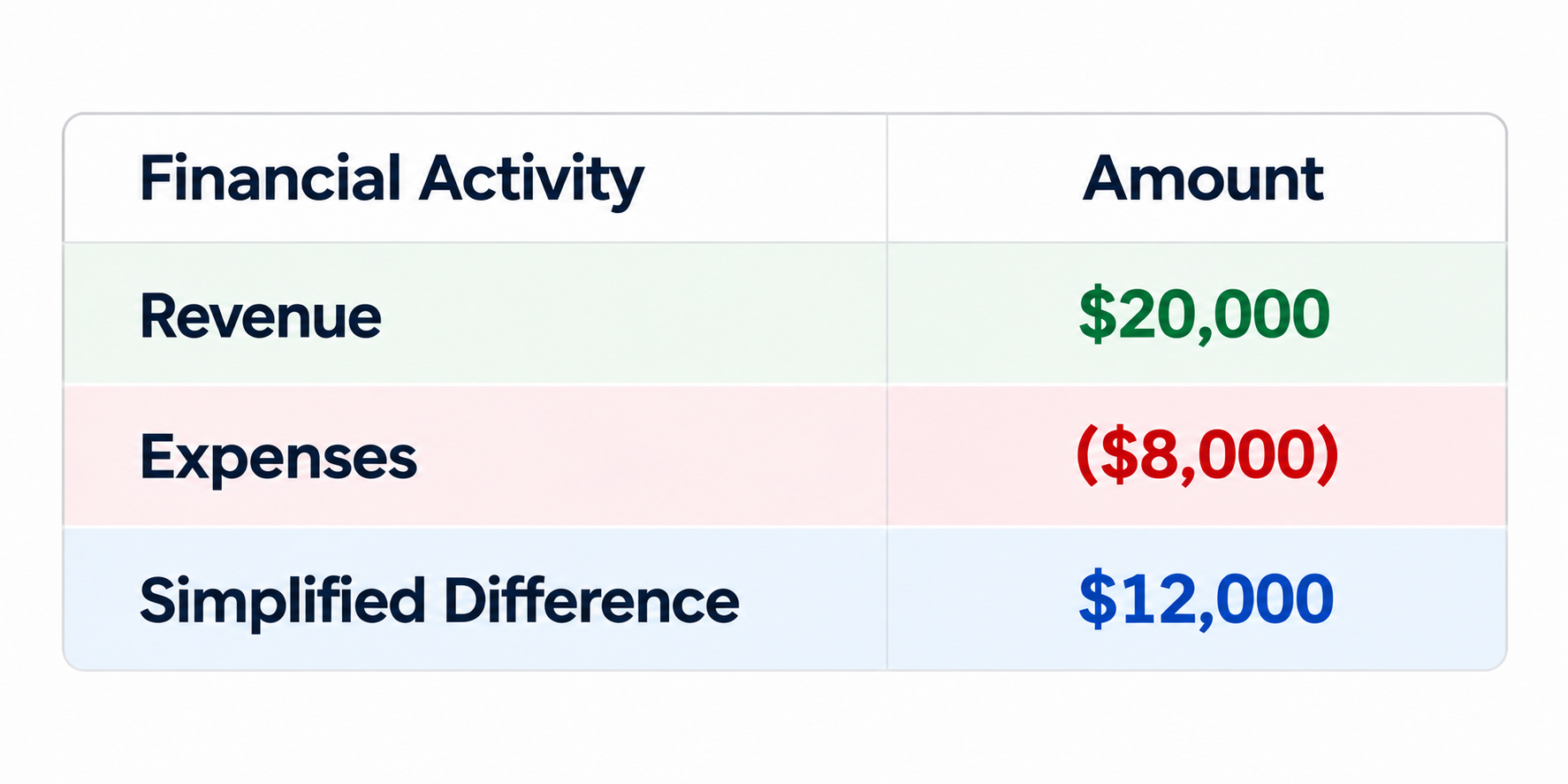
This $12,000 difference doesn't automatically mean Alex has $12,000 available to withdraw personally. Other liabilities, transaction timing, accounting adjustments, and tax considerations may affect the company's actual financial position. The example illustrates a fundamental principle:
Revenue tells you what the business earns. Expenses tell you what it costs to operate. Bookkeeping helps you understand the relationship between them.
Keep Business and Personal Finances Separate
Mixing business and personal transactions is one of the most common bookkeeping challenges. Imagine Alex uses his business bank account to pay for a software subscription, a client-related expense, personal groceries, and a family vacation.
Now his accountant needs to identify which transactions belong to the business and how the others should be recorded. This creates unnecessary work and makes financial reporting more complicated.
Maintaining a dedicated business bank account and properly recording owner contributions, withdrawals, and other personal transactions can simplify bookkeeping significantly. The accounting treatment of owner transactions depends on the entity and the nature of each transaction. Not every payment made from a business account is a deductible business expense.
What Is Bank Reconciliation, and Why Does It Matter?
Bank reconciliation means comparing the transactions recorded in your bookkeeping system with the transactions appearing on your bank statement. Imagine your bookkeeping records show a bank balance of $9,450. But your actual bank statement shows $9,250.
There's a $200 difference. Instead of ignoring it, you need to investigate. Perhaps a bank fee wasn't recorded. Maybe a transaction was entered twice, a payment was recorded incorrectly, or the difference relates to transaction timing.
Reconciliation helps identify these discrepancies and maintain more reliable financial records. For many small businesses, reconciling bank accounts monthly is a useful habit. Accurate bookkeeping isn't just about recording transactions. It's also about confirming that those records are correct.
A Real-World Example: One Month of Business Activity
Let's return to Alex, who operates a U.S. consulting company. During October, his business has the following activity:
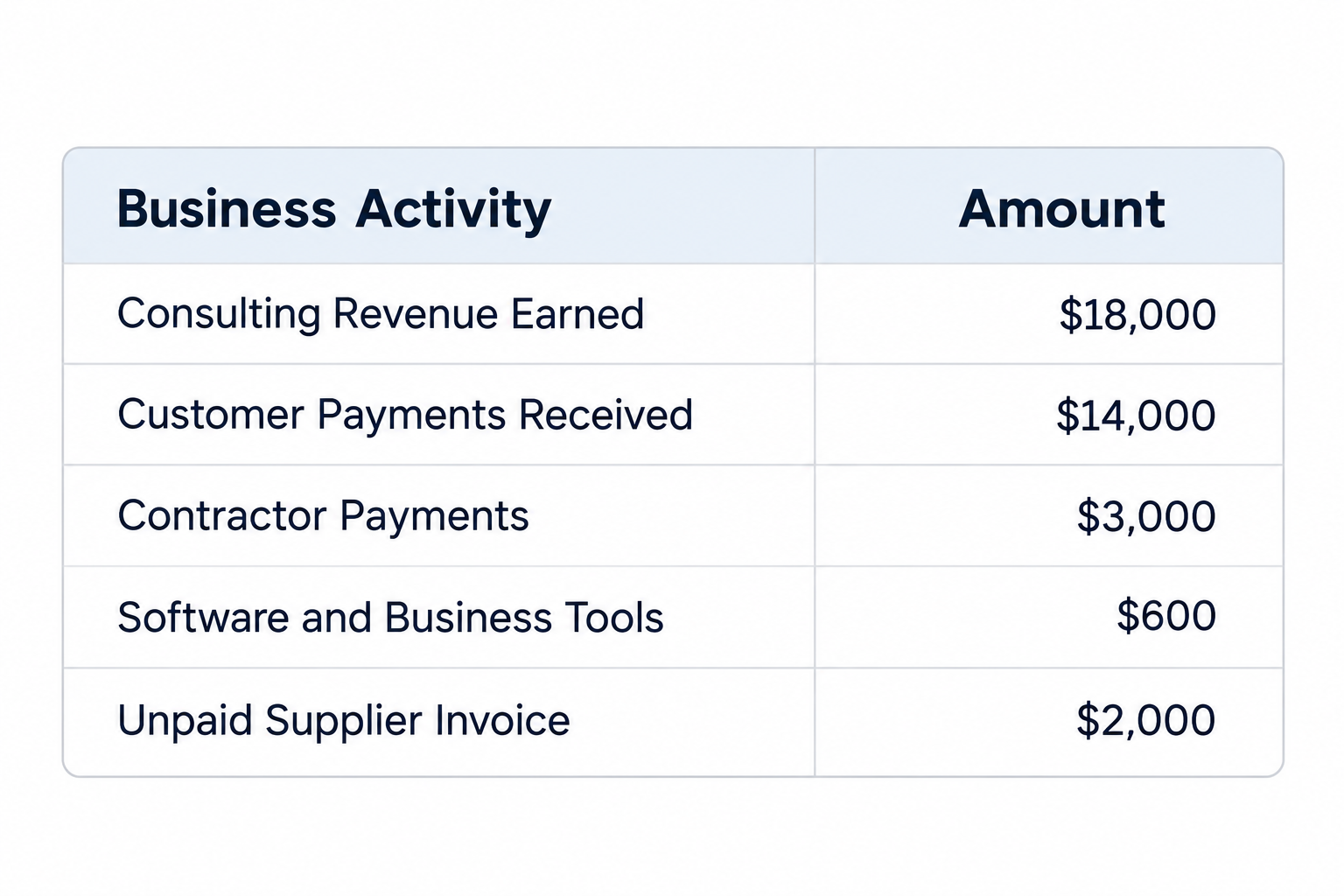
If Alex only checks his bank account, he may see the customer payments and expenses that actually moved through the account. But that doesn't tell the complete story. He also needs to understand revenue earned but not yet collected and obligations that haven't been paid. This is why bookkeeping distinguishes between:
Revenue earned and cash received. Bills received and bills paid. Customer invoices outstanding and payments collected. The accounting method used by the business determines how income and expenses are recognized for accounting and applicable tax purposes. The important lesson is that the timing of a business transaction and the timing of its payment aren't always the same.
Bookkeeping and Tax Preparation Work Together
Many entrepreneurs start thinking about bookkeeping only when tax season approaches. By then, they may have accumulated months of unorganized transactions, missing receipts, and unmatched bank deposits.
Tax preparation becomes much harder when financial records aren't maintained consistently. Bookkeeping helps organize the information needed to prepare tax returns, including revenue, expenses, owner transactions, and other financial activity. However, bookkeeping and tax preparation aren't identical.
Bookkeeping records financial activity. Tax preparation applies the relevant tax rules and reporting requirements. For international entrepreneurs, this distinction can be especially important because the tax classification and ownership of a U.S. company may affect its reporting obligations. Accurate bookkeeping supports tax compliance, but it doesn't replace a proper tax analysis.
Do You Need Accounting Software?
Not every new business needs a complicated accounting system. A small consulting business with a limited number of monthly transactions may have different needs than an e-commerce company processing hundreds of customer payments. Some businesses may begin with a simple, organized recordkeeping process.
Others may benefit from accounting software that helps manage invoices, expenses, bank transactions, financial reports, and reconciliation. As transaction volume increases, a more structured system may become valuable.
The important question isn't:
“Which accounting software has the most features?”
It's:
“Which system can my business maintain accurately and consistently?”
The best bookkeeping system is one that provides reliable information and fits the company's operations.
The Biggest Bookkeeping Mistake
One of the most common mistakes entrepreneurs make is waiting until the end of the year to organize their financial records. Receipts disappear. Customer payments become difficult to match to invoices.
Expenses are forgotten or misclassified. Bank statements no longer match the bookkeeping records. And preparing financial reports takes longer than necessary. The solution isn't necessarily more complicated accounting software. It's a repeatable process. Consistency beats last-minute cleanup.
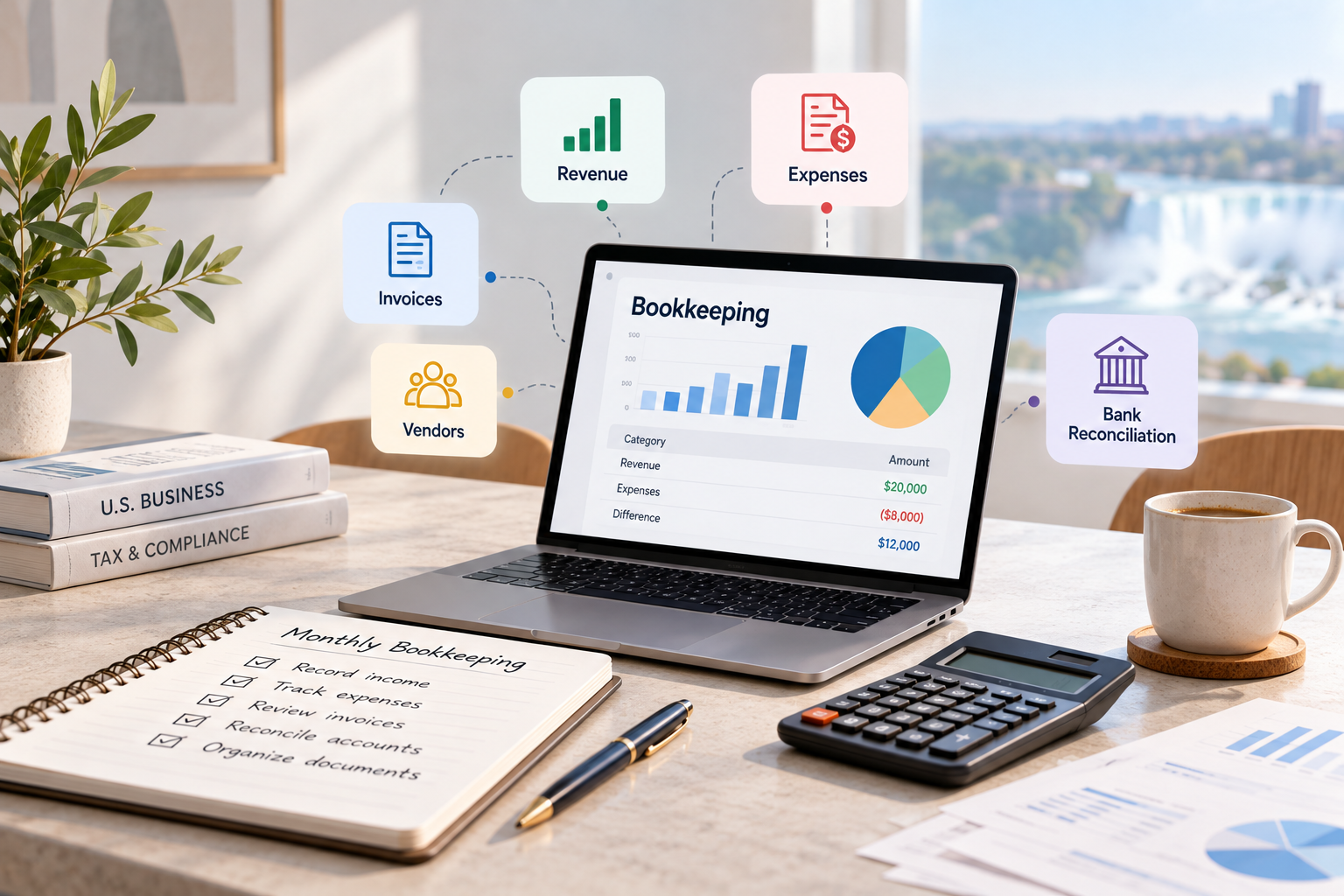
Your Monthly Bookkeeping Checklist
A consistent monthly routine can make bookkeeping much easier.
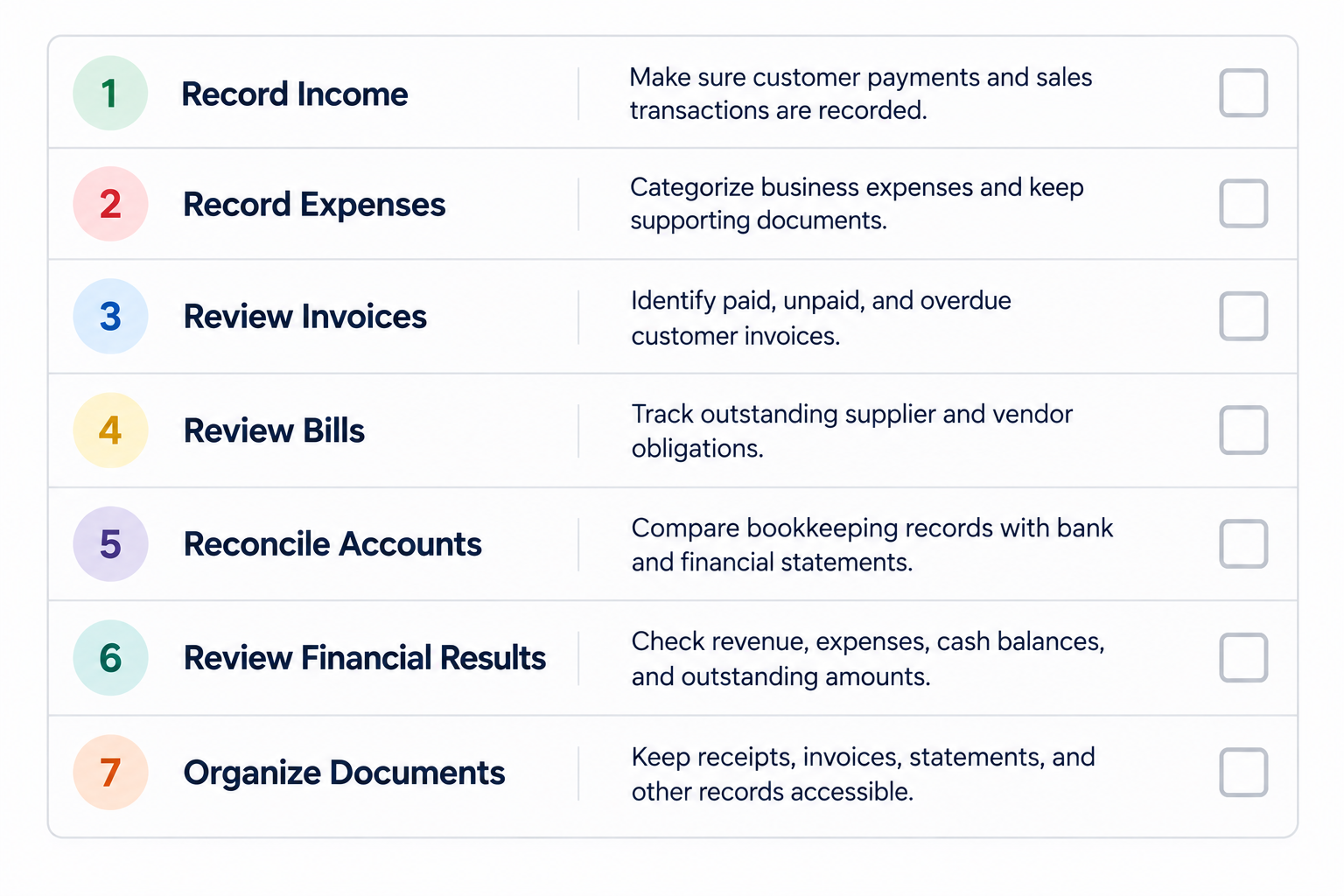
You don't need to master every accounting concept before getting started. You need a system that helps you maintain reliable financial records month after month.
Build Financial Clarity, Not Just Financial Records
Bookkeeping isn't simply an administrative requirement. It's part of understanding how your business operates. A well-organized bookkeeping system helps you monitor income and expenses, track outstanding invoices, understand upcoming obligations, and prepare more effectively for tax season.
At InceptaBiz, we help international entrepreneurs build the financial foundation behind their U.S. businesses—from company formation and business banking to bookkeeping support, tax compliance, and ongoing business operations.
Our goal isn't simply to help you establish a company. It's to help you understand and manage the financial responsibilities that come with running one. Because a successful business needs more than revenue. It needs financial clarity.
Education comes first. Then execution.
Frequently Asked Questions
What is bookkeeping for a small business?
Bookkeeping is the systematic recording and organization of a business's financial transactions, including revenue, expenses, payments, invoices, and other financial activity.
Is bookkeeping the same as accounting?
Not exactly. Bookkeeping focuses on recording and organizing financial transactions, while accounting also involves interpreting, analyzing, and reporting financial information.
Is my bank balance the same as my business profit?
No. Your bank balance shows available cash at a particular moment, while profit depends on revenue, expenses, and applicable accounting principles.
What is the difference between accounts receivable and accounts payable?
Accounts receivable represents amounts customers owe your business, while accounts payable represents amounts your business owes suppliers or vendors.
How often should I reconcile my business bank account?
For many small businesses, monthly reconciliation is a useful practice. Businesses with higher transaction volumes may benefit from more frequent reviews.
Can I use a spreadsheet for bookkeeping?
A spreadsheet may be suitable for some simple businesses if it supports accurate, consistent records and applicable recordkeeping requirements. More complex operations may benefit from dedicated accounting software.
Does bookkeeping help with U.S. tax filing?
Yes. Organized bookkeeping records help support tax preparation by documenting business income, expenses, and other financial transactions. However, bookkeeping alone doesn't determine the correct tax treatment or filing requirements.
Should I keep personal and business expenses separate?
Yes. Separating personal and business finances generally makes recordkeeping easier and helps identify transactions that belong to the business.
Do I need bookkeeping if my U.S. LLC has very few transactions?
Even businesses with limited activity benefit from maintaining accurate financial records. The appropriate level of detail depends on the business's structure, transactions, and reporting requirements.