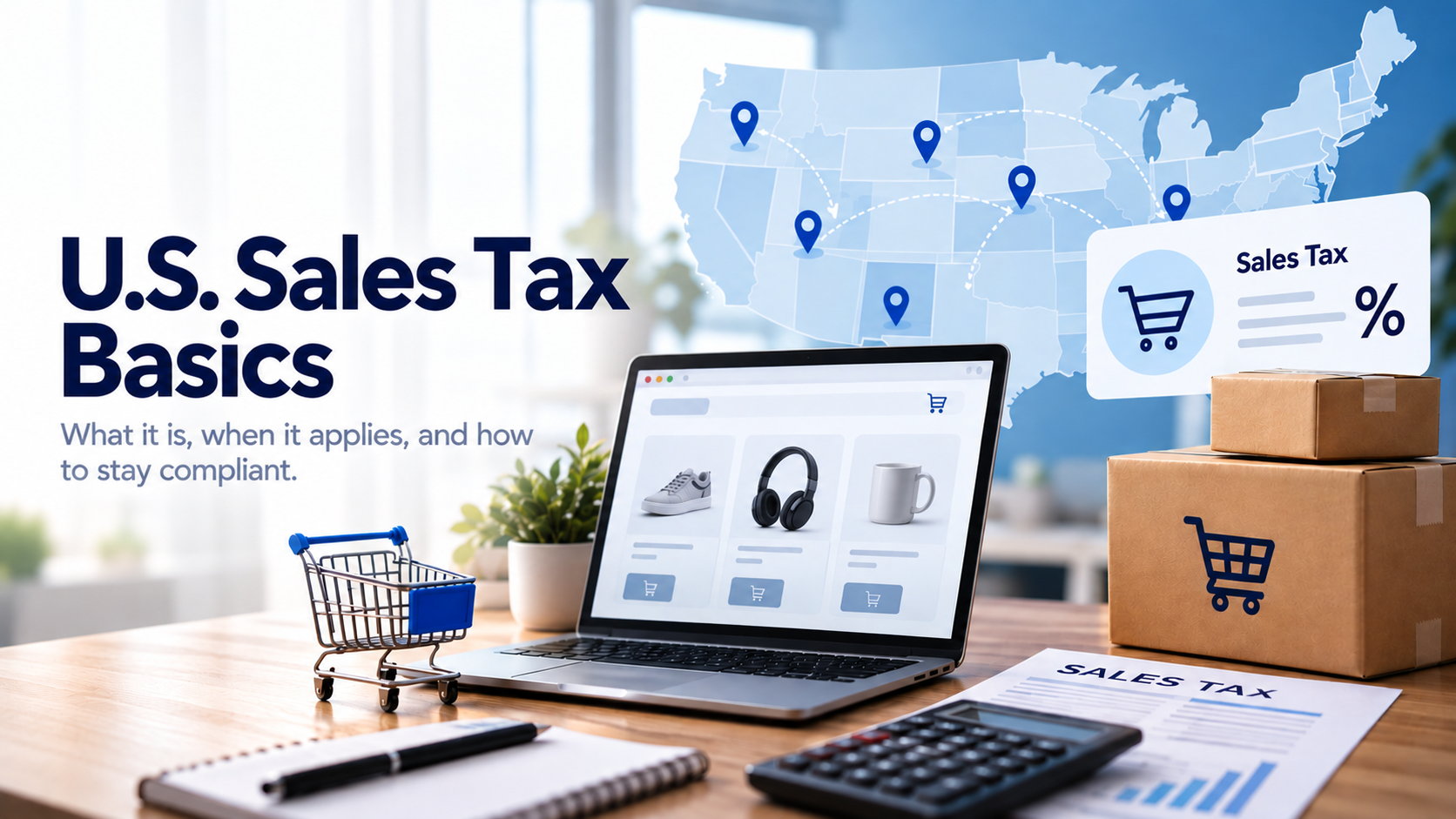
You formed a U.S. company. You opened a business bank account. Customers are placing orders, invoices are being sent, and payments are coming in. Then someone asks:
“Are you collecting sales tax?”
Suddenly, a new set of questions appears.
Do you need to charge sales tax to every customer? What happens when you sell to customers in different states? Does sales tax apply if you live outside the United States? What if you sell through Amazon, Etsy, or your own website?
And perhaps the most important question:
Is sales tax the same as income tax?
No.
Understanding the difference is the first step toward building a reliable U.S. sales tax process.
Sales Tax Is Not Income Tax
One of the most common misunderstandings among new entrepreneurs is treating all taxes as the same thing. Income tax generally focuses on income and taxable profit. Sales tax generally applies to certain transactions involving taxable products or services.
Imagine Alex sells a product for $100.
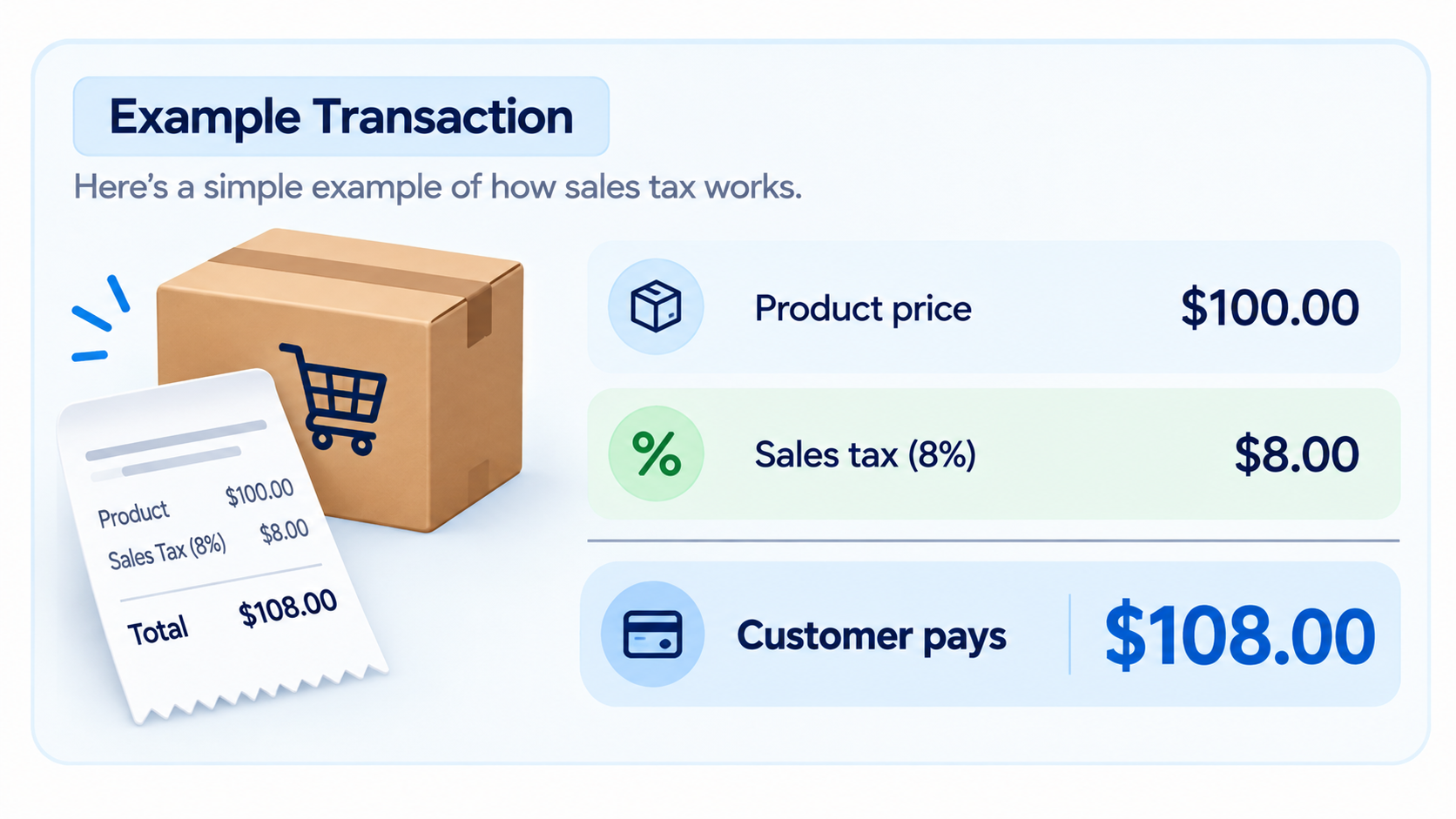
The additional $8 isn't simply extra business profit. When a business is required to collect sales tax, it generally has an obligation to report and remit the tax to the appropriate authority.
This distinction matters for bookkeeping, financial reporting, and tax compliance. Income tax focuses on income. Sales tax focuses on the transaction.
Is Everything You Sell Subject to Sales Tax?
Before asking how much sales tax to charge, start with a more fundamental question:
Is what you're selling taxable in that state?
Different states can treat products and services differently. Depending on the jurisdiction, sales tax rules may vary for physical products, digital downloads, software, SaaS subscriptions, consulting services, professional services, clothing, food, and other products.
For example, a state may tax certain digital products while another state treats similar transactions differently.
This means two common assumptions can be misleading:
“I sell online, so everything I sell is taxable.”
Or:
“I provide services, so sales tax never applies.”
Neither is universally correct.
The taxability of a transaction depends on the product or service and the rules of the relevant jurisdiction.
What Is Sales Tax Nexus?
Now we reach one of the most important concepts in U.S. sales taxation:
Nexus.
In simple terms, nexus refers to a sufficient connection between a business and a state that can create tax obligations. Traditionally, business owners often associated nexus with physical presence.
For example, a business may have a connection to a state through:
An office or physical store
Employees working in that state
Inventory stored in a warehouse
Other physical business activities
Physical presence still matters. But it isn't the only way a business can establish nexus. Today, many states also have rules based on the amount of business activity a seller conducts with customers in that state. This is known as economic nexus.
What Is Economic Nexus?
Imagine Alex lives outside the United States and operates an online store through his U.S. company. He sells products to customers in State A. But he has no office, employees, or physical store there.
Alex might assume:
“I don't have a physical presence in that state, so I don't need to collect sales tax.”
That assumption may be incorrect.
Under economic nexus rules, a business may become obligated to register, collect, and remit sales tax when its sales activity exceeds a state's applicable threshold, even without traditional physical presence.
The specific thresholds and calculation methods vary by state. This changes the question international entrepreneurs should ask.
Instead of focusing only on:
“Where was my LLC formed?”
They should also ask:
“Where are my customers, and how much business am I doing in each state?”
Every U.S. State Has Different Sales Tax Rules
There is no single nationwide sales tax system that provides one universal answer for every business. States can establish different requirements concerning:
Taxable products and services
Registration requirements
Economic nexus thresholds
Sales tax rates
Local sales taxes
Filing frequencies
Marketplace transactions
Even the way states calculate economic nexus can differ. For example, one state may evaluate gross sales while another may apply different definitions or exclusions.
That's why relying on a statement such as:
“You only need to register after $100,000 in sales.”
can be misleading.
The relevant threshold, measurement period, and calculation rules must be evaluated for each state.
A Real-World Example: Selling Across Multiple States
Imagine Alex operates a U.S. e-commerce company.
During the year, his company generates:
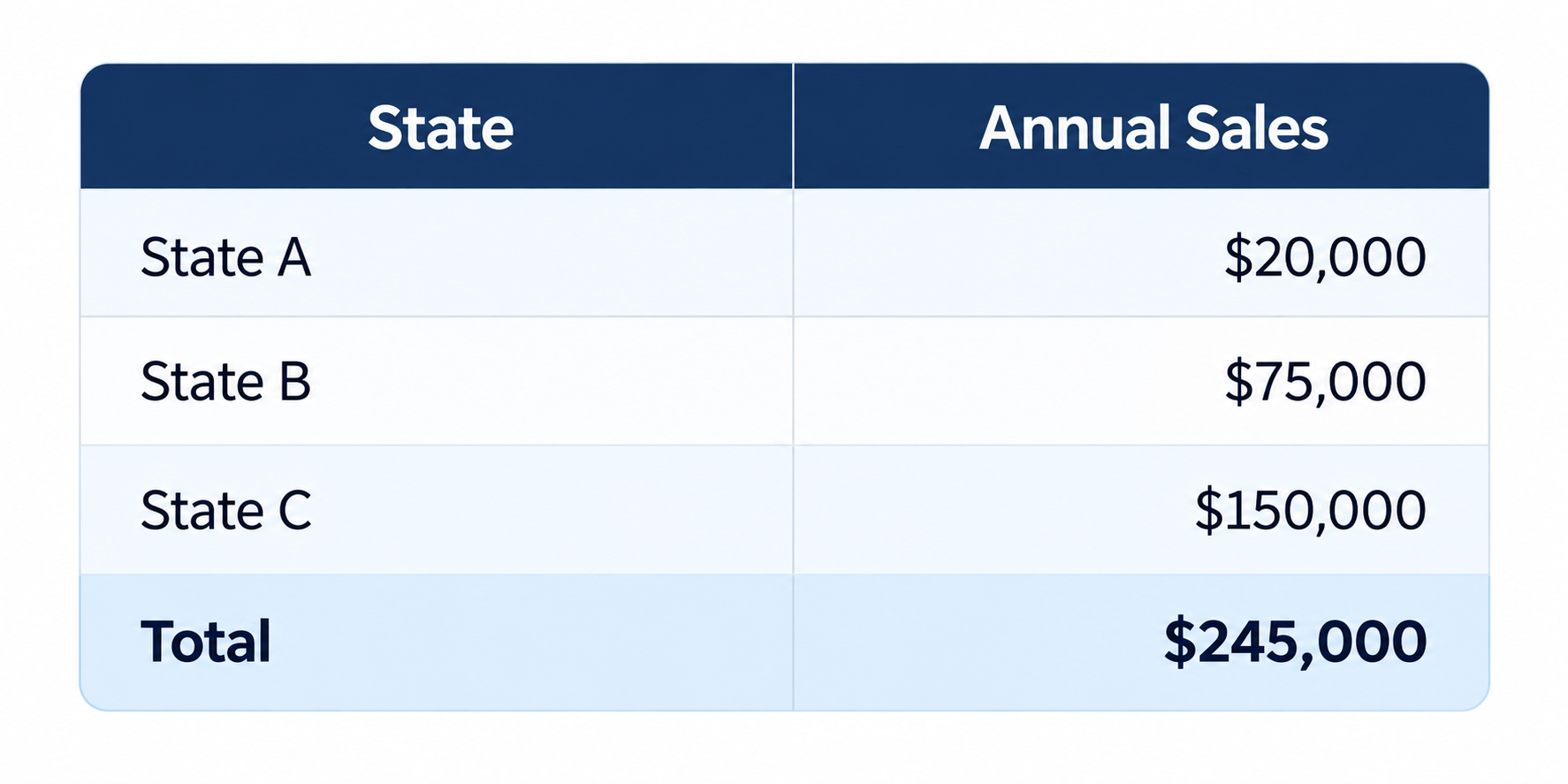
Alex formed his company in Wyoming. At first, he assumes that Wyoming is the only state he needs to consider. But sales tax doesn't work that way.
For each state, Alex should evaluate the products he sells, their taxability, the location of customers, the amount of sales activity, and whether his business has physical or economic nexus.
He should also determine whether transactions occur through his own website or through a marketplace.
Importantly, the sales amounts alone don't establish whether Alex has crossed a particular state's threshold. The applicable state rules must be checked. The location of your LLC doesn't automatically determine all your sales tax obligations.
What If You Sell Through Amazon, Etsy, or Another Marketplace?
Many international entrepreneurs sell through platforms such as Amazon and Etsy. This introduces another important concept:
Marketplace Facilitator Laws.
Under these laws, qualifying marketplaces may be responsible for collecting and remitting sales tax on certain transactions they facilitate. This can simplify part of the compliance process for marketplace sellers. But it doesn't necessarily eliminate every sales tax obligation a seller may have.
For example, a business might sell through Amazon while also operating its own website. It may also maintain inventory in certain states or have other activities that create nexus. The marketplace may handle collection and remittance for qualifying marketplace transactions, while the seller may still have separate registration, filing, or direct-sales obligations.
The important question is:
“Which transactions is the marketplace handling, and which transactions remain my responsibility?”
Shopify Is Different From a Marketplace
This is another distinction online sellers should understand. Imagine Alex operates his own online store using Shopify. His store may use software that calculates applicable sales tax or helps collect it at checkout. But using an e-commerce platform doesn't automatically transfer the business's legal sales tax responsibilities to that software provider. This differs from qualifying marketplace facilitator arrangements, where the marketplace may be legally responsible for collecting and remitting tax on facilitated transactions.
Technology can help calculate and manage sales tax. It doesn't automatically determine or eliminate your compliance obligations.
How Does Sales Tax Compliance Work?
Once a business determines that it has a sales tax obligation, it needs an organized process.
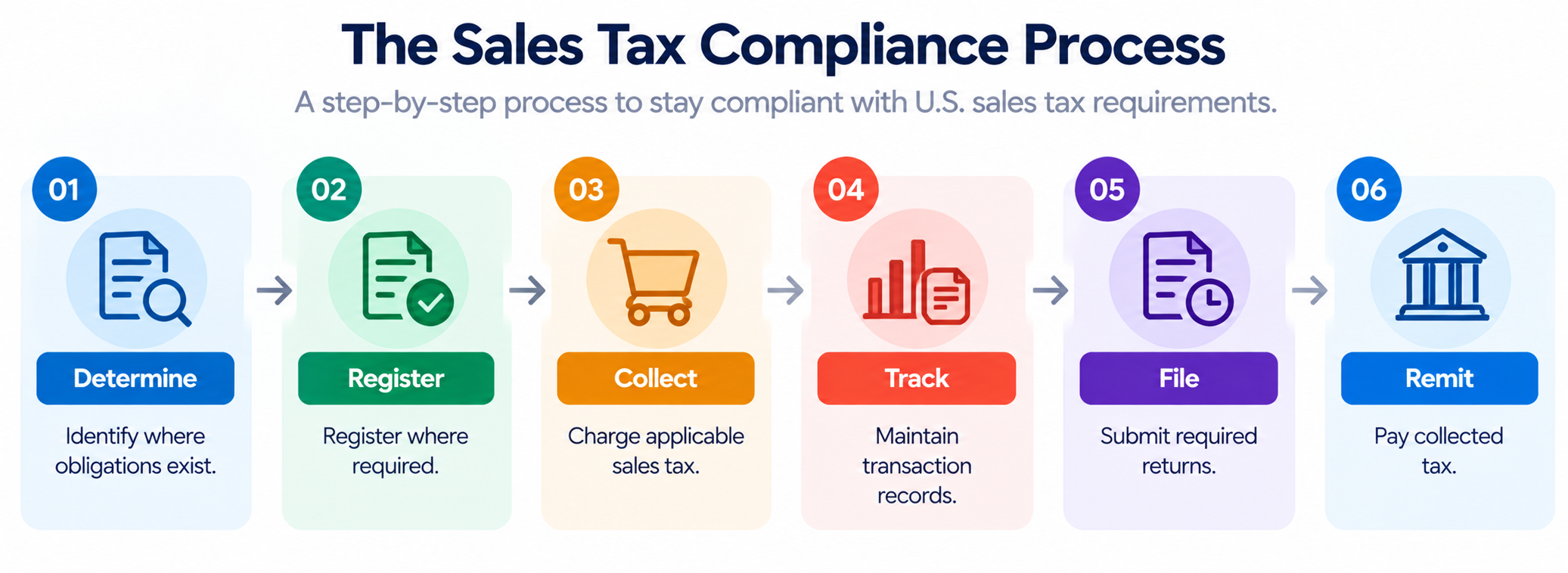
Registration is particularly important. A business that becomes obligated under a state's rules generally needs to follow that state's registration, collection, filing, and remittance requirements.
Sales tax compliance isn't simply adding a percentage to the customer's invoice. It's an ongoing financial and regulatory process.
Sales Tax and Bookkeeping Must Work Together
Remember our earlier episodes about business banking, payments, and invoicing? Sales tax becomes another part of that financial system. Imagine a customer purchases a product for $100 and pays an additional $8 in sales tax. The total payment received is $108. But your bookkeeping system should distinguish the $100 sale from the $8 collected as sales tax.
Why?
Because the sales tax portion may represent a liability owed to the relevant tax authority rather than additional business revenue. Your records should help you answer two separate questions: How much did the business sell? How much sales tax did the business collect? These are not the same thing. A properly organized accounting process helps keep those amounts separate and makes sales tax reporting easier.
Don't Collect Sales Tax Everywhere Just to Be Safe
Some business owners assume the safest strategy is to charge sales tax on every transaction. But collecting sales tax without understanding the applicable requirements isn't a reliable compliance approach. Before collecting sales tax in a jurisdiction, businesses should evaluate whether they are required or authorized to collect it and whether registration is necessary.
The goal isn't to collect as much sales tax as possible.
It's to:
Collect the correct tax, in the correct jurisdiction, when required.
The Biggest Sales Tax Mistake
One of the most common mistakes growing businesses make is waiting too long to monitor their sales tax exposure. Imagine Alex's online business grows rapidly.
At the end of the year, he realizes:
“We sold products to customers in 30 different states.”
Now he needs to reconstruct an entire year's transactions.
He must identify sales by state, sales by marketplace, direct website sales, product categories, transaction dates, and applicable threshold calculations. That's considerably harder than monitoring those activities as they happen. Sales tax compliance becomes easier when businesses start tracking their sales by state early.
Five Questions to Ask About Your Sales Tax Exposure
Before deciding whether your company needs to collect sales tax, ask:
1. What products or services do I sell?
Different types of products and services may receive different tax treatment.
2. Which states are my customers located in?
Customer locations help identify which jurisdictions need attention.
3. How much have I sold into each state?
Sales activity is relevant to evaluating economic nexus thresholds.
4. Do I have employees, inventory, offices, or other physical activities in any state?
Physical presence can create obligations independently of sales thresholds.
5. Which transactions occur through marketplaces, and which occur directly through my business?
This distinction helps determine potential collection and remittance responsibilities.
These five questions provide a practical starting point for a Sales Tax Exposure Map.
A Simple Framework for Understanding Sales Tax
When evaluating sales tax for your U.S. business, remember this sequence:
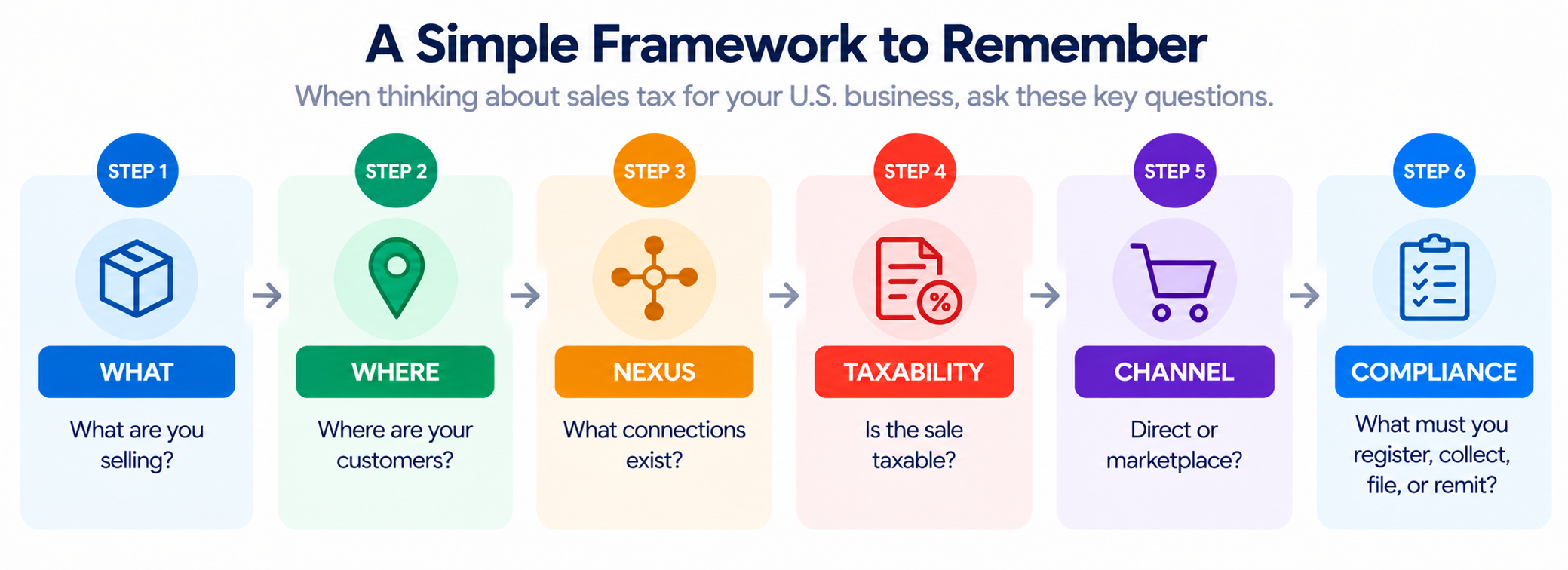
This framework helps you understand sales tax as a business process rather than a single percentage added at checkout.
Build a Sales Tax System, Not Just a Tax Calculation
Sales tax compliance doesn't need to begin with memorizing the tax rules of every U.S. state.
It begins with understanding your business.
What are you selling?
Where are your customers?
Where does your business have nexus?
Which transactions are taxable?
And which collection, reporting, and payment obligations apply?
At InceptaBiz, we help international entrepreneurs connect their U.S. business operations with the financial and compliance systems behind them—from company formation and bookkeeping to tax compliance and ongoing business support.
Because good compliance isn't about doing more. It's about understanding what applies to your business and doing it correctly. Education comes first. Then execution.
Frequently Asked Questions
Is sales tax the same as income tax?
No. Income tax generally focuses on income and taxable profit, while sales tax generally applies to certain taxable sales transactions. They are separate tax systems.
Do I need to collect sales tax if I don't live in the United States?
Possibly. Living outside the United States doesn't automatically eliminate sales tax obligations. The analysis depends on factors such as what you sell, where your customers are located, and whether your business has physical or economic nexus in a state.
What is economic nexus?
Economic nexus is a connection created through a business's economic activity in a state. Remote sellers may be required to register and collect sales tax when they exceed the state's applicable threshold, even without a physical presence.
Does every state have the same sales tax threshold?
No. States can establish different thresholds, measurement periods, calculation methods, and registration requirements. Businesses should evaluate each relevant state's rules.
Does Amazon automatically handle all my sales tax obligations?
Not necessarily. Amazon may collect and remit sales tax on qualifying marketplace transactions under applicable marketplace facilitator laws. However, sellers may still have separate obligations depending on their direct sales, physical presence, registrations, and the states involved.
Does Shopify automatically collect and remit sales tax for my business?
Using Shopify or another e-commerce platform doesn't automatically transfer all legal compliance responsibilities to the platform. Businesses should understand their own registration, collection, filing, and remittance requirements.
Should I collect sales tax in every state to be safe?
No. Businesses should determine their obligations and applicable registration requirements before collecting sales tax. The objective is to collect the correct tax where required.
Is sales tax collected from customers considered business revenue?
Sales tax collected for remittance to a tax authority generally should be tracked separately from the underlying sale. Proper bookkeeping helps distinguish sales revenue from tax liabilities.