
You own a U.S. company. But you don't live in the United States. So do you have to pay U.S. taxes? This is one of the most important—and most misunderstood—questions for international entrepreneurs. Some founders hear:
“You own a U.S. LLC, so you automatically pay U.S. income tax.”
Others hear:
“You don't live in America, so you don't pay U.S. tax.”
Both statements can be misleading. For a non-resident entrepreneur, the tax analysis can depend on much more than where the company was formed. Your U.S. tax status, business structure, type and source of income, location of business activities, connection to a U.S. trade or business, and applicable tax treaties can all matter. So instead of asking:
“Do non-residents pay U.S. tax?”
A better question is:
“What type of income do I have, where does that income come from, and how does U.S. tax law treat it?”
First: What Does “Non-Resident” Actually Mean?
In everyday conversation, someone might say:
“I'm a non-resident because I live outside the United States.”
But for U.S. federal tax purposes, the term has a more specific meaning. U.S. tax law has rules for determining whether an individual is treated as a resident alien or nonresident alien.
That distinction matters because the two are generally taxed differently. Resident aliens are generally taxed similarly to U.S. citizens on worldwide income. Nonresident aliens, by contrast, are generally subject to U.S. income tax on certain U.S.-source income and income effectively connected with a U.S. trade or business.
Before trying to calculate tax, therefore, start with:
What is my U.S. tax status?
Owning a U.S. Company Doesn't Answer the Entire Tax Question
Imagine Alex lives outside the United States and forms a U.S. LLC.
His company has:
A U.S. EIN
A U.S. bank account
U.S. customers
A payment processor
A registered agent in the United States
Alex might assume:
“My company is American, so all of my income must be taxable in America.”
That's too simple.
But the opposite assumption—
“I live abroad, so nothing can be taxable in America.”
—is also too simple.
For nonresident taxpayers, two concepts become particularly important:
1. Source of Income
2. Connection to a U.S. Trade or Business
These concepts can have a significant impact on the tax analysis. Episode 08 — Taxes for Non-Resi…
Where Does the Income Come From?
One of the biggest mistakes international founders make is assuming that the location of the customer, company, invoice, or bank account automatically determines where income is sourced. That's not always the case.
For example, when dealing with compensation for personal services, the IRS generally looks at where the services are physically performed. If services are performed in the United States, the compensation is generally U.S.-source income.
If a nonresident performs the services outside the United States, the source analysis can be different. This gives us an important principle:
Where the money is deposited does not necessarily determine where the income is sourced. Having a U.S. bank account doesn't automatically make income U.S.-source income. And simply having a U.S. customer doesn't necessarily answer the question either.
The nature of the income matters.
What Is ECI?
Now we reach one of the most important concepts in U.S. international taxation:
ECI — Effectively Connected Income
ECI generally refers to income that is effectively connected with the conduct of a trade or business in the United States. When a nonresident alien is engaged in a U.S. trade or business, effectively connected income is generally taxed after allowable deductions at graduated rates.
For example, performing personal services in the United States can result in a foreign person being treated as engaged in a U.S. trade or business, subject to applicable rules and exceptions.
For an international entrepreneur, the more useful question may therefore be:
“Am I engaged in a U.S. trade or business, and is my income effectively connected with that business?”
That's much more informative than simply asking:
“Do I have an LLC?”
What Is FDAP?
Another important category is:
FDAP — Fixed, Determinable, Annual, or Periodical Income
FDAP can include certain types of income such as:
Interest
Dividends
Rents
Royalties
Certain other U.S.-source income
U.S.-source FDAP income received by a nonresident that isn't effectively connected with a U.S. trade or business is generally subject to a 30% gross-basis tax, unless a tax treaty or another applicable rule provides a lower rate or exemption.
This is different from ECI.
A simple way to remember the distinction is:
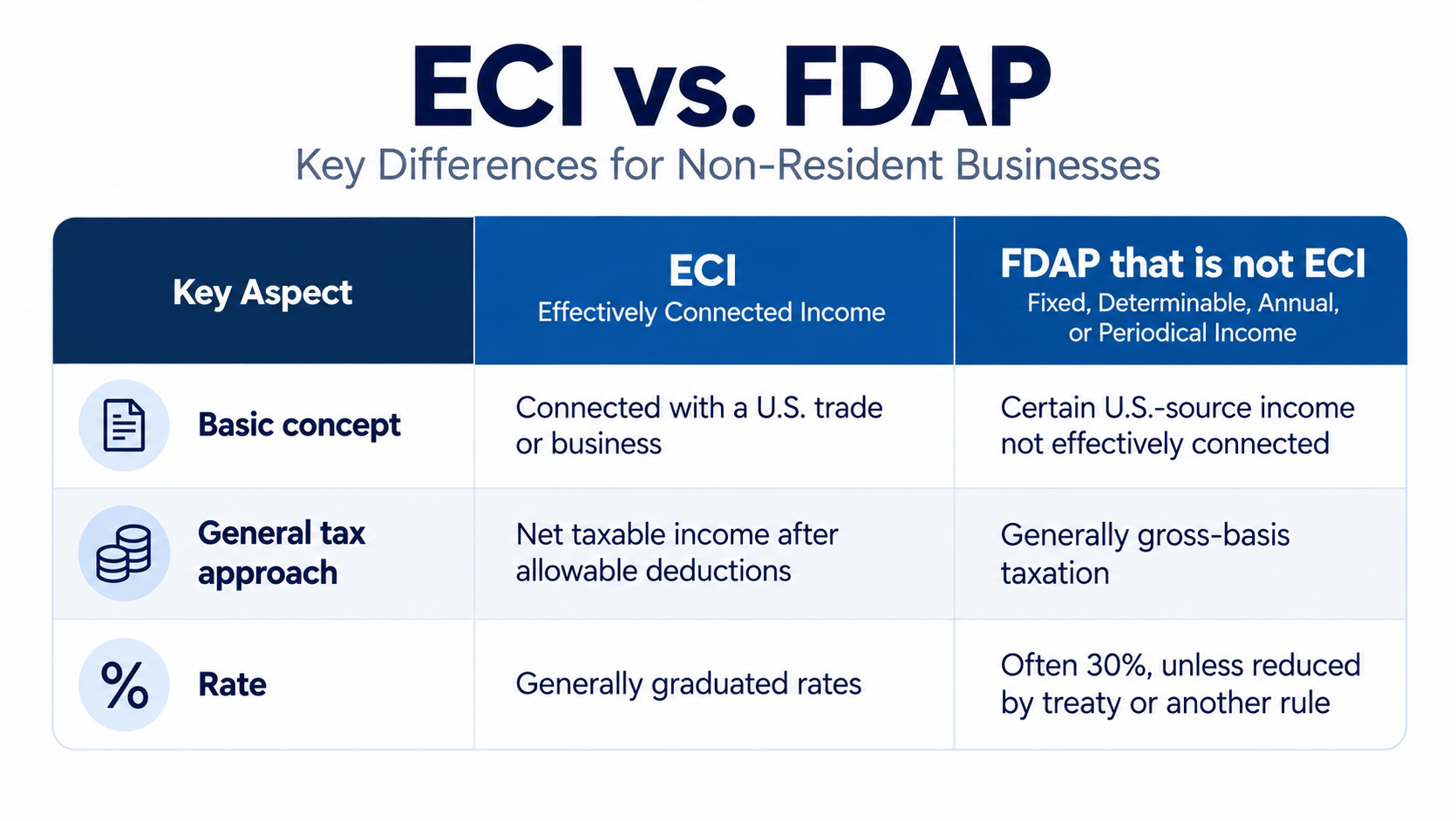
But understanding that these categories exist can help you ask much better questions.
A Real-World Example
Let's return to Alex. Alex lives outside the United States and owns a U.S. LLC providing consulting services. His customer is in New York. The customer pays:
$10,000
into Alex's U.S. business bank account. Alex might assume:
U.S. customer + U.S. company + U.S. bank account = U.S.-source service income
Not necessarily. For personal service income, one of the key sourcing factors is generally where the services were actually performed.
If Alex performed the consulting work entirely outside the United States, that fact can be highly relevant to the tax analysis.
However, that's not necessarily the end of the analysis. The company's structure, business activities, U.S. presence, type of income, treaty provisions, and other circumstances may still matter. That's why international tax questions rarely have reliable one-line answers.
What If Alex Works While He's in the United States?
Now change one detail. Alex travels to the United States and performs part of the consulting work while physically present there. The tax analysis may change. Why? Because compensation for personal services performed in the United States is generally treated as U.S.-source income, subject to specific exceptions and applicable treaty provisions.
This demonstrates an important principle:
Small changes in facts can create very different tax outcomes.
Where the founder works matters.
What the company sells matters.
Where employees operate matters.
Where inventory or property is located can matter.
International taxation is highly dependent on the actual facts.
What About U.S. Tax Treaties?
The United States has income tax treaties with various countries.
Depending on the treaty and the circumstances, certain types of income may qualify for reduced tax rates, exemptions, or other treatment. For example, the standard 30% rate that may apply to certain U.S.-source FDAP income can sometimes be reduced under an applicable treaty.
But there's an important warning:
Tax treaty benefits aren't automatic.
The relevant treaty, type of income, eligibility requirements, documentation, and individual circumstances all matter.
So saying:
“My country has a tax treaty with the United States.”
is the beginning of the analysis.
Not the end.
Zero Tax Does Not Necessarily Mean Zero Filing
This is one of the most important distinctions for international founders. There are actually two different questions:
“Do I owe U.S. tax?”
and
“Do I have a U.S. filing or reporting requirement?”
Those questions aren't always identical. For example, a nonresident alien who is required to file a U.S. individual income tax return generally uses Form 1040-NR. A business can also have separate tax-return or information-reporting obligations depending on its structure and ownership.
This leads to one of the most important principles in this entire series:
Zero tax does not necessarily mean zero filing.
A founder may have important compliance obligations even when the ultimate tax liability isn't what they initially expected.
Don't Focus Only on Where Your LLC Was Formed
Imagine a founder asks:
“My LLC is in Wyoming. How much tax do I pay?”
The problem is that Wyoming tells us only one fact. A proper analysis may also need to consider:
Where does the owner live?
What is the owner's U.S. tax status?
What does the business sell?
Where are services performed?
Where are employees and contractors located?
Where is inventory located?
Where is property located?
Is there a U.S. trade or business?
What type of income is earned?
Does a tax treaty apply?
The company's address alone can't answer those questions.
Six Questions to Answer Before Estimating Your U.S. Tax
Before asking:
“How much U.S. tax do I owe?”
Prepare answers to these six questions:
1. Where do I personally live?Prepare
2. What is my U.S. tax residency status?
3. What type of entity do I own?
4. What type of income does the business generate?
5. Where are the services or business activities actually performed?
6. In which countries and U.S. states does the business have meaningful activity?
Those answers give your tax advisor a much better starting point than simply saying:
“I own a U.S. LLC.”
A Simple Framework for Non-Resident Taxation
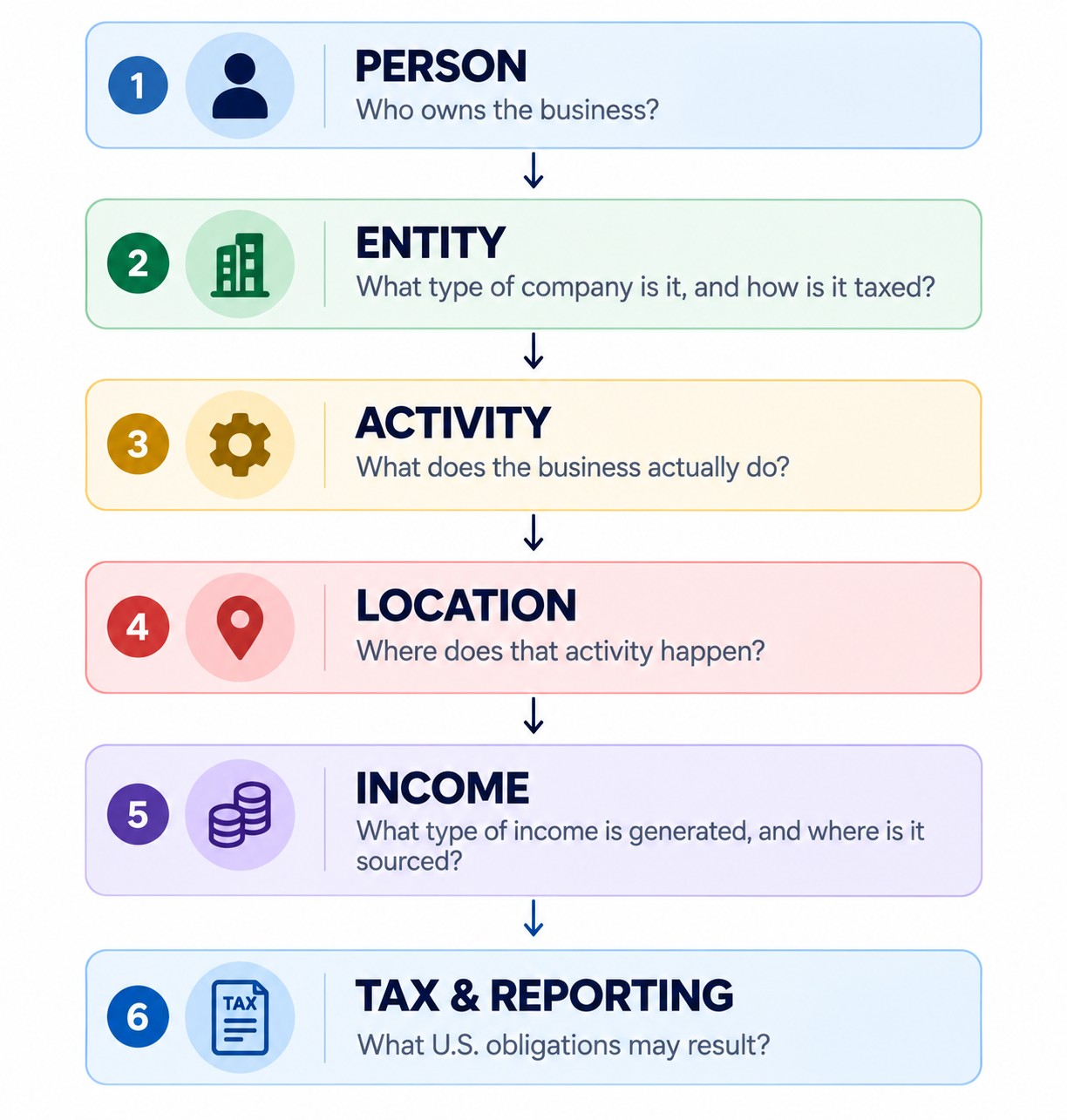
That's much more useful than starting with:
“Wyoming LLC = zero tax?”
Understand the Facts Before the Tax Answer
International taxation doesn't need to begin with complicated tax terminology. It begins with understanding your business.
At InceptaBiz, we help international founders connect the pieces behind their U.S. businesses—from company formation and bookkeeping to tax compliance and ongoing business support. ,
The goal isn't to give every international founder the same tax answer. It's to understand which tax questions apply to your particular business and circumstances.
Because when it comes to international taxation:
The facts come first. The tax answer comes second.
Education comes first. Then execution.
Frequently Asked Questions
Do I have to pay U.S. taxes if I live outside the United States?
Living outside the United States doesn't automatically eliminate U.S. tax or filing obligations. The answer can depend on your U.S. tax status, income source, business activities, connection to a U.S. trade or business, and other facts.
Does owning a U.S. LLC mean all my income is taxable in the United States?
Not automatically. Owning a U.S. company alone doesn't determine the tax treatment of all your income. The source and type of income, business activities, tax classification, U.S. presence, and other circumstances can matter.
If my client is in the United States, is my consulting income automatically U.S.-source?
Not necessarily. For compensation from personal services, where the services are physically performed is generally a key sourcing factor.
What is ECI?
ECI means Effectively Connected Income. It generally refers to income effectively connected with conducting a trade or business in the United States.
What is FDAP?
FDAP means Fixed, Determinable, Annual, or Periodical Income. It can include certain types of U.S.-source income such as interest, dividends, rents, and royalties. When it isn't effectively connected with a U.S. trade or business, it is generally subject to a 30% gross-basis tax unless an applicable treaty or other rule provides different treatment.
Can a tax treaty reduce U.S. taxes for a non-resident?
Potentially. Depending on the specific treaty, income type, eligibility requirements, documentation, and circumstances, a treaty may provide reduced rates, exemptions, or other treatment. Treaty benefits aren't automatic.
If I owe zero U.S. income tax, do I still need to file?
Possibly. Tax-payment obligations and filing or information-reporting obligations aren't always the same. This is why zero tax doesn't necessarily mean zero filing.