You formed a U.S. company. Your business is operating. Money is coming in.
And eventually, one question appears:
“How much U.S. tax do I have to pay?”
For international entrepreneurs, this is one of the most common—and most misunderstood—questions.
Some founders hear:
“If you have a U.S. company, you pay U.S. tax on everything.”
Others hear:
“If you don't live in the United States, you don't have to worry about U.S. taxes.”
Neither statement is a good way to understand the system. U.S. taxation can depend on several factors, including your business structure, federal tax classification, type and source of income, business activities, and the tax status of the people involved.
So before asking:
“How much tax will I pay?”
Start with a better question:
“What taxes could apply to my business—and why?”
U.S. Taxes Are Not Just One Tax
One of the most important concepts for new entrepreneurs to understand is that “U.S. tax” isn't one single tax. Depending on the business and its activities, a company may encounter:
Federal income tax
State income or franchise taxes
Employment taxes
Sales and use taxes
Certain excise taxes
Other state or local tax obligations
But that doesn't mean every business pays every one of these taxes.
Your business activity helps determine which tax questions matter.
A consulting company with no employees can have a very different tax profile from an e-commerce business selling products across multiple states.
Federal Taxes vs. State Taxes
One of the first distinctions to understand is the difference between federal and state taxation.
Federal Taxes
Federal taxes are administered nationally, primarily through the Internal Revenue Service. How a business is taxed federally can depend heavily on its classification. A corporation may be subject to corporate income tax. A partnership generally passes income and other tax items through to its partners.
An LLC can receive different federal tax treatment depending on its ownership and elections.
Your legal entity and your federal tax classification aren't always the same thing.
Simply saying “I have an LLC” doesn't necessarily tell you how the business is treated for federal tax purposes.
State Taxes
Now add another layer. The United States doesn't have one single state tax system. Each state has its own rules.
State-level obligations can depend on factors such as where your company operates, where employees are located, where sales occur, your type of business, economic nexus rules, and your entity structure.
That's why:
The state where you formed your company isn't automatically the only state that matters for tax purposes.
As your business expands, other states may become relevant.
Income Tax Is Only One Part of the Picture
When entrepreneurs hear “tax,” they usually think of income tax. But businesses may have other responsibilities. For example, a company with employees may need to consider employment taxes involving wages, withholding, Social Security and Medicare taxes, and federal unemployment tax.
An e-commerce company selling taxable products may also need to consider sales tax obligations.
Those obligations can depend on where the business has sufficient connection—or nexus—with a state. The broader principle is:
Taxes follow business activity.
As your operations change, your tax obligations can change too.
Revenue Is Not the Same as Taxable Income
Imagine your company generates:
$100,000 in revenue
and has:
$40,000 in legitimate business expenses.
A common assumption might be:
“Then I pay tax on $60,000.”
But tax calculations aren't always that simple. Tax rules determine which expenses are deductible, when they can be deducted, and how different types of income and expenses are treated.
That's why business owners should understand the relationship between:
Revenue → Expenses → Profit → Taxable Income
These concepts are connected, but they aren't automatically identical. And this is exactly where good bookkeeping becomes important.
Business Revenue Is Not Automatically Your Personal Income
Suppose Alex owns a U.S. company. His company receives:
$150,000 during the year.
Alex might think:
“The company made $150,000, so that's my $150,000.”
Not necessarily. The company's revenue and the owner's personal income aren't automatically the same thing. Tax treatment can depend on the entity's classification and how money is earned, retained, distributed, or paid.
This is also why founders shouldn't treat a business bank account like a personal wallet. Your business needs its own financial records. Your personal finances need their own records. And your tax reporting should reflect the actual structure of the business.
A Real-World Example
Imagine Alex is an international entrepreneur who owns a U.S. consulting company.
During the year, the company:
Generates consulting revenue
Pays software expenses
Pays contractors
Maintains a U.S. business bank account
Serves customers in multiple countries
Alex's first question might be:
“How much U.S. tax do I owe?”
But before answering that, several other questions need to be understood.
What type of entity does Alex own?
How is it classified for federal tax purposes?
Where does the business operate?
What type of income does it generate?
Does it have employees or contractors?
Where does Alex personally live, and what is his tax status?
Only after understanding the facts can the tax picture be evaluated properly.
Tax planning starts with facts—not assumptions.
Why Bookkeeping Matters for Taxes
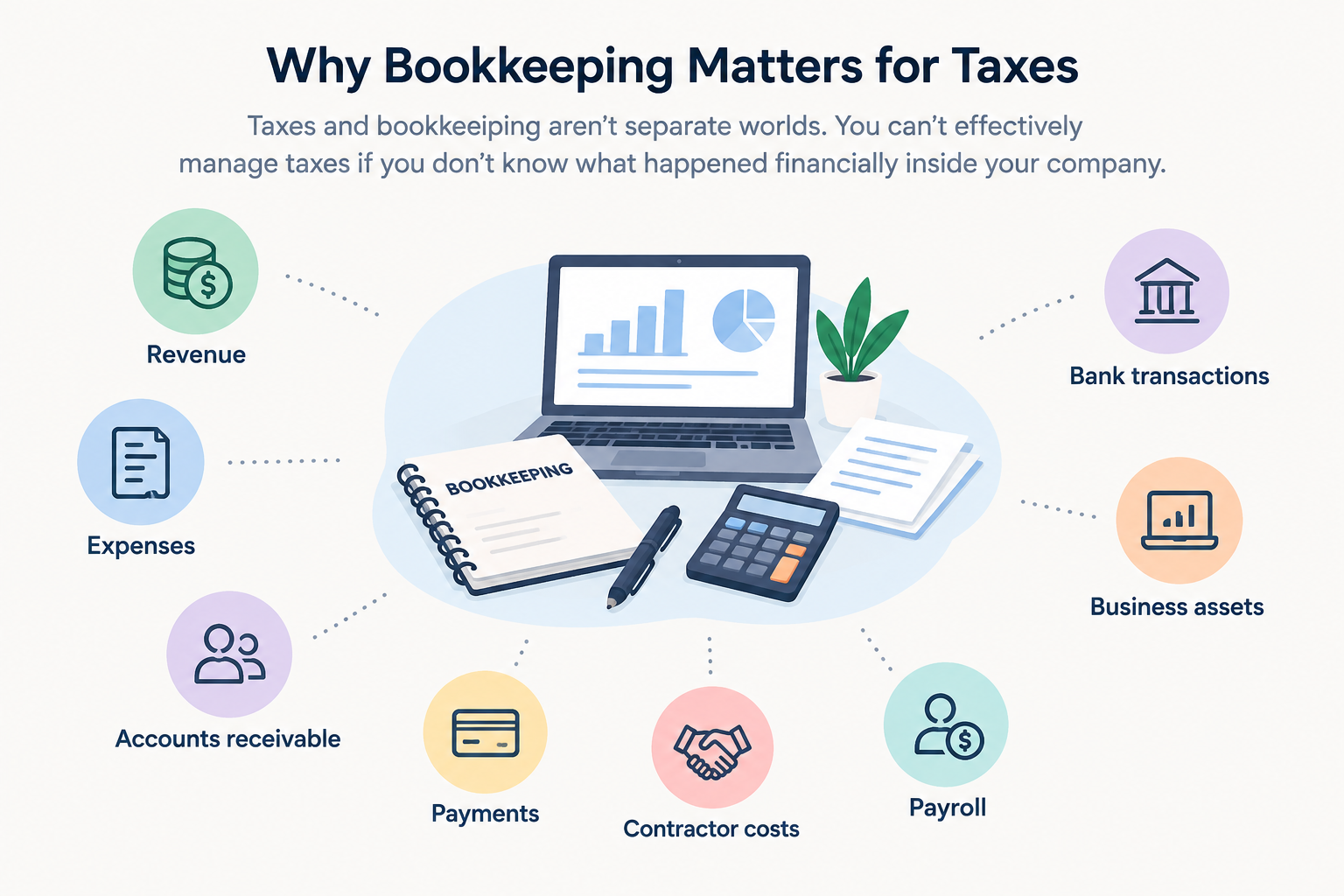
It doesn't eliminate your tax obligations. But it makes tax preparation and financial decision-making much more organized. A simple way to think about it is:
Bookkeeping tells the story of what happened. Tax compliance applies the tax rules to that story.
Tax Compliance Is a Year-Round Process
Many entrepreneurs think about taxes only when a return is due. That's usually too late to start understanding the business's tax position.
A professional tax process can involve keeping accurate books, tracking revenue and expenses, understanding filing requirements, monitoring deadlines, setting aside funds when appropriate, and reviewing changes in business activity throughout the year.
Tax compliance isn't simply:
“File a tax return once a year.”
It's an ongoing part of operating a business.
The Biggest U.S. Tax Mistake
One of the biggest mistakes founders make is assuming that having a U.S. company automatically creates one simple U.S. tax bill. The reality can involve multiple layers:
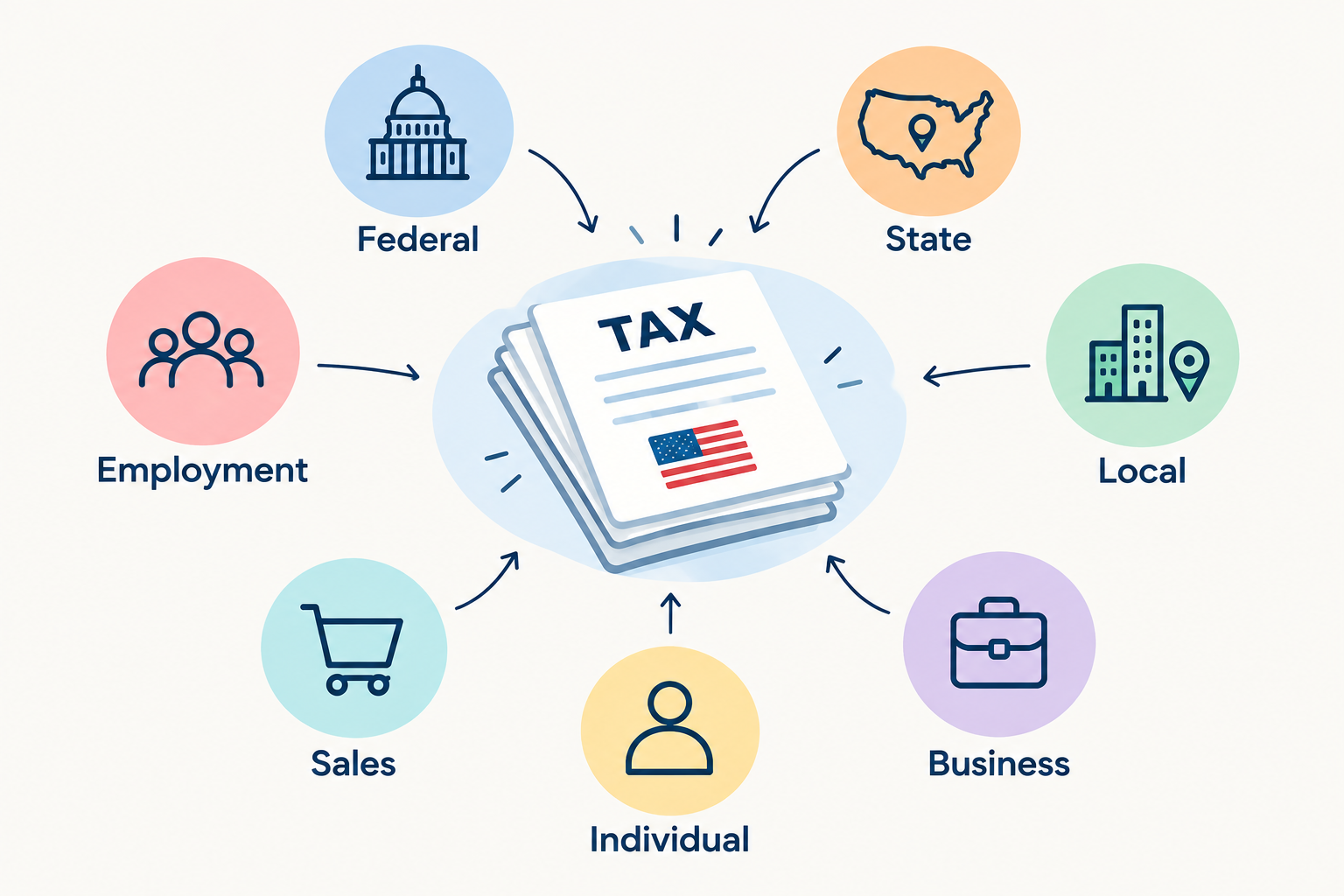
And for international entrepreneurs, there may also be additional cross-border considerations. You don't need to memorize the entire U.S. tax code. You need to understand which rules may apply to your particular business.
Five Questions to Ask Before Estimating Your Taxes
Before trying to calculate a tax bill, answer these five questions:
1. What type of business entity do I have?
LLC, corporation, partnership, or another structure?
2. How is my business classified for federal tax purposes?
Your legal entity alone may not answer this question.
3. Where does my business operate and generate activity?
Different states and jurisdictions may become relevant.
4. What type of income does the business receive?
Consulting income, product sales, or another type of revenue?
5. What records and filings do I need to maintain?
Good records are the foundation of accurate tax compliance.
If you can't answer these questions yet, don't start by guessing your tax bill.
Start by understanding your business.
Build a Tax System, Not Just a Tax Return
The goal of tax planning isn't simply to reach the end of the year and file paperwork. Your tax process should connect with the rest of your financial system:
Business Activity → Banking → Bookkeeping → Financial Records → Tax Compliance
At InceptaBiz, we help international entrepreneurs build the financial and compliance foundation behind their U.S. businesses—from company formation and business banking to bookkeeping, tax compliance, business operations, and ongoing support. Because the best tax strategy starts with understanding the business itself.
Education comes first. Then execution.
Frequently Asked Questions
Does having a U.S. company automatically mean I owe U.S. tax?
Not necessarily in one simple or universal way. The tax picture can depend on your entity structure, federal tax classification, type and source of income, business activities, and the tax status of the people involved.
Is an LLC automatically taxed as an LLC?
“LLC” describes a legal structure, but federal tax treatment can differ. Depending on its ownership and elections, an LLC may be treated as a disregarded entity, partnership, or corporation for federal tax purposes.
If I formed my company in one state, do I only pay taxes there?
Not necessarily. Other states can become relevant depending on where your business operates, employees are located, sales occur, and other state-specific rules such as economic nexus.
Is business revenue the same as taxable income?
No. Taxable income depends on applicable tax rules, including how income and deductions are treated. Revenue, profit, and taxable income shouldn't automatically be treated as interchangeable terms.
Does my company's revenue automatically become my personal income?
Not necessarily. The tax treatment can depend on the business's classification and how money is earned, retained, distributed, or paid to the owner.
Do international founders have different tax considerations?
They can. In addition to the company's structure and activities, an international founder's residence and tax status can be relevant when evaluating the overall tax picture.