Starting a U.S. business is an exciting milestone. You register your company, receive your EIN, open a business bank account, and begin working with customers. Invoices go out. Payments come in. Expenses accumulate. Then, sooner than expected, tax season arrives. And suddenly, you're asking questions you may not have considered when forming your company.
Which tax return should I file?
Does every LLC file the same form?
What if my company didn't make any money?
What if I don't live in the United States?
For many new business owners, especially international entrepreneurs, filing the first U.S. business tax return can seem overwhelming.
But here's the key:
Your first tax return isn't just about completing an IRS form. It's about accurately reporting what happened inside your business during the year. Understanding the process early can make your first filing experience significantly easier.
Your First Tax Return Begins Before Tax Season
Many entrepreneurs believe tax preparation starts when they contact an accountant. In reality, it begins with the financial activity of the business throughout the year. Every customer payment, invoice, business expense, contractor payment, bank transfer, and owner transaction contributes to your company's financial history. These records eventually become the foundation of your tax return. For example, imagine a company receives $50,000 in customer payments during its first year.
That number alone doesn't tell the complete financial story. The company may also have operating expenses, owner contributions, withdrawals, and other transactions that need to be classified correctly. This is why accurate bookkeeping is so important.
Good bookkeeping doesn't just help you understand your business. It helps prepare your business for tax season.
Does Every LLC File the Same Tax Return?
No. And this is one of the most important concepts new LLC owners should understand. An LLC is a legal structure formed under state law, but its federal tax classification can vary.
Depending on ownership and applicable tax elections, an LLC may be treated as a disregarded entity, partnership, or corporation. For example, a domestic single-member LLC is generally disregarded for federal income tax purposes unless it elects corporate taxation.
A domestic LLC with multiple members is generally classified as a partnership unless it elects corporate treatment. This distinction affects which federal tax returns and reporting requirements may apply.
Instead of asking:
“What tax return does an LLC file?”
Ask:
“How is my LLC classified for federal tax purposes?”
Understanding Common U.S. Business Tax Forms
Different business structures may have different federal filing requirements.
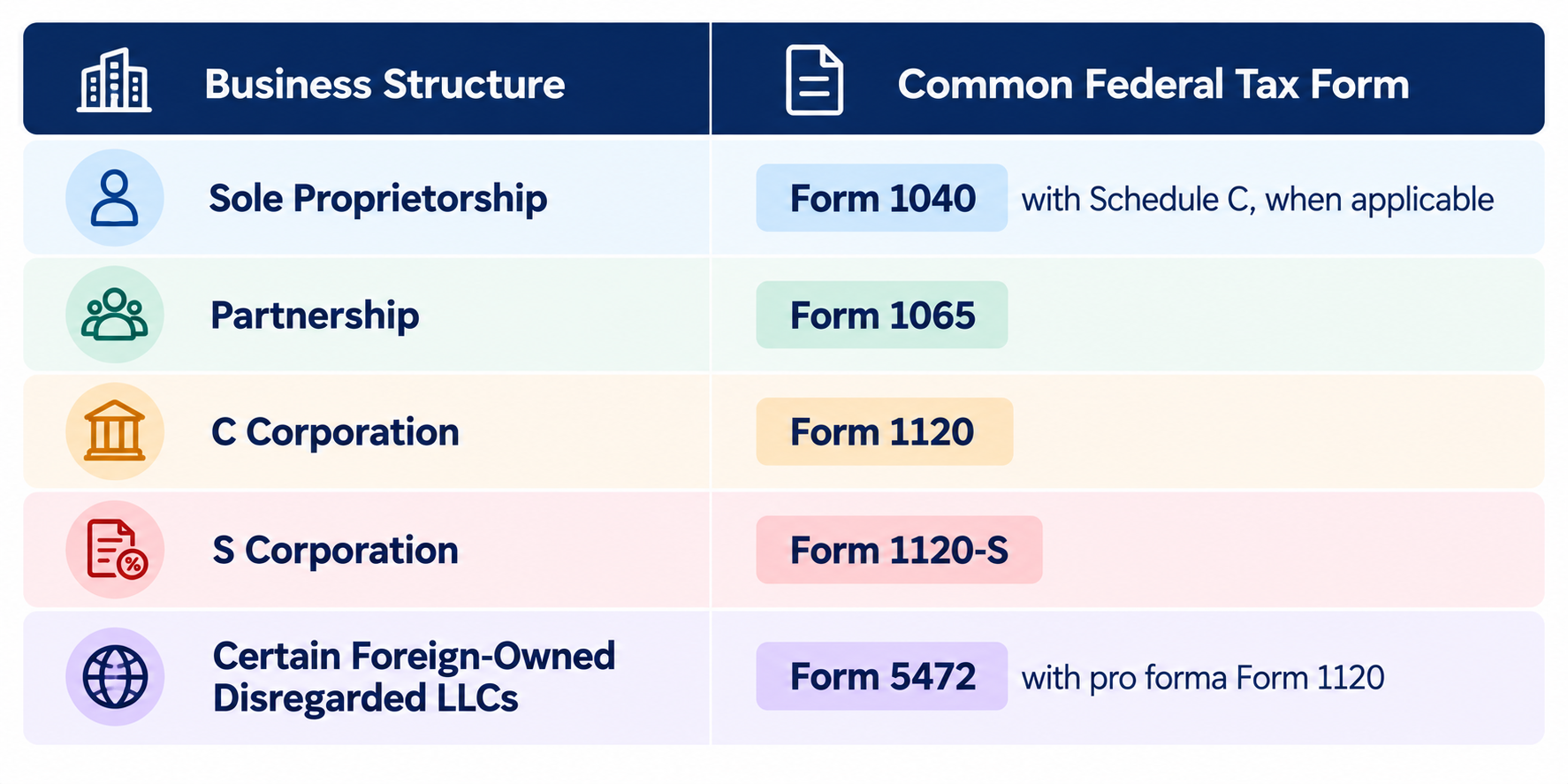
These are common examples rather than a complete list of filing requirements. For example, partnerships generally file Form 1065 and provide Schedule K-1 information to their partners.
C corporations generally file Form 1120, while qualifying S corporations generally file Form 1120-S. For individual-owned disregarded entities, income tax reporting may occur at the owner level, depending on the circumstances.
The correct filing requirement depends on the business's tax classification—not simply the fact that it is an LLC.
Special Filing Requirements for Foreign-Owned LLCs
International entrepreneurs should pay particular attention to this section. Imagine Alex lives outside the United States and owns 100% of a U.S. single-member LLC. His LLC hasn't elected corporate tax treatment, so it is generally considered a disregarded entity for federal income tax purposes.
Alex assumes:
“My LLC is disregarded, so I don't need to file anything.”
That assumption may be incorrect.
Certain foreign-owned U.S. disregarded entities must file Form 5472 with a pro forma Form 1120 when applicable reporting requirements are met.
These requirements can involve reportable transactions with foreign related parties, including certain transactions between the company and its foreign owner. This is particularly important because an LLC may have information-reporting obligations even when it doesn't owe federal income tax.
The lesson is simple:
Zero income tax does not necessarily mean zero filing.
What If Your Business Made No Profit?
One of the most common questions new business owners ask is:
“Do I still need to file if my company didn't make any money?”
The answer depends on the company's circumstances. Consider a business that generates no revenue during its first year but incurs $2,500 in startup and operating expenses. The owner might assume that no profit means no tax return.
However, filing obligations aren't determined solely by whether the business made money. The company's tax classification, ownership, activities, and reportable transactions can all matter.
For certain foreign-owned entities, information-reporting obligations may exist even without significant revenue. No profit doesn't automatically mean no filing requirement.
Tax Returns vs. Information Returns
Not every IRS filing is designed primarily to calculate tax. Some returns determine taxable income and tax liability. Others report information about business activities, ownership, or certain transactions. For example, a partnership generally files Form 1065 to report partnership income and other tax information, even though the partnership itself generally isn't taxed in the same manner as a C corporation.
Similarly, Form 5472 serves an information-reporting purpose for certain foreign-owned entities and reportable transactions.
This means every business owner should ask two separate questions:
1. Does my business owe U.S. tax?
2. Does my business have a tax filing or information-reporting obligation?
Both questions are essential to understanding U.S. tax compliance.
What Documents Do You Need for Your First Tax Return?
Before preparing your first tax return, organize your business records.
A practical checklist includes:
Business Information
Legal company name and EIN
Formation documents
Business address
Ownership information
Federal tax classification
Income and Expense Records
Customer invoices and payment records
Payment processor reports
Software subscriptions
Advertising and marketing expenses
Professional fees
Contractor and payroll expenses
Other business expenses
Banking and Financial Records
Business bank statements
Credit card statements
Payment platform reports
Year-end bookkeeping reports
Owner and Related-Party Transactions
Owner contributions
Owner withdrawals or distributions
Loans between the owner and business
Other related-party transactions
Depending on your business, you may also need payroll information, contractor documentation, and sales tax records.
Organizing these documents before tax season can reduce delays and make the preparation process more efficient.
Why Bookkeeping Matters More Than You Think
Imagine two business owners preparing their first tax returns. The first owner has twelve months of bank statements but hasn't categorized any transactions. Customer payments are mixed with owner contributions. Personal expenses appear in the business account. Transfers are difficult to identify. The accountant must spend time reconstructing the company's financial activity.
The second owner maintains bookkeeping records throughout the year. Revenue and expenses are categorized, bank accounts are reconciled, and owner transactions are properly identified.
For the second business, tax preparation is much more straightforward.
That's why:
Bookkeeping prepares the numbers. Tax preparation applies the tax rules.
A Practical Example: Revenue, Expenses, and Owner Transactions
Let's say Alex owns a U.S. company and lives outside the United States.
At the end of the year, his financial records show:
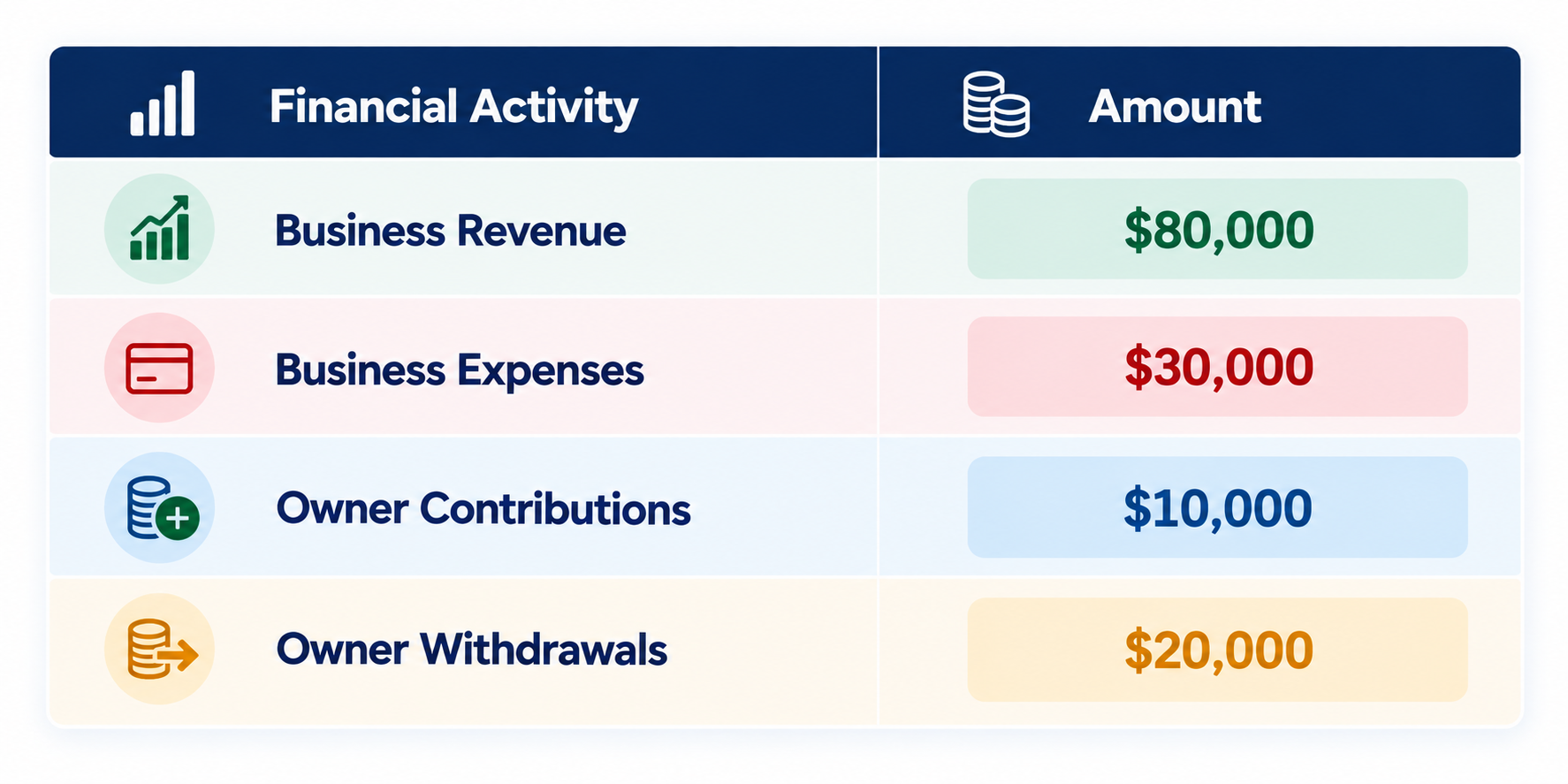
Alex might assume that every deposit into the company bank account counts as business revenue. But the $10,000 owner contribution isn't necessarily revenue from customers. Similarly, the $20,000 owner withdrawal isn't automatically a deductible business expense.
The correct treatment depends on the entity's classification and the nature of each transaction. Before preparing the return, the accountant needs to understand what happened, why the money moved, and how each transaction should be classified.
Only then can the appropriate tax rules be applied.
When Is Your First Business Tax Return Due?
Not every U.S. business tax return has the same filing deadline. For example, partnership returns are generally due on the 15th day of the third month following the end of the partnership's tax year. Most calendar-year individual income tax returns are generally due on the 15th day of the fourth month following year-end.
Corporate filing deadlines depend on the corporation's tax year and applicable rules. Specific circumstances, weekends, holidays, and valid extensions can affect actual deadlines.
The important question isn't:
“Is every business tax return due April 15?”
It's:
“Which return am I required to file, and when is that specific return due?”
What If You Need More Time to File?
Sometimes business records aren't ready, or additional documentation is needed. Depending on the return, an extension may be available. However, business owners should understand an important distinction: An extension to file isn't necessarily an extension to pay.
Receiving additional time to submit a return doesn't automatically extend the deadline for paying taxes. Filing and payment obligations should therefore be evaluated separately.
The Biggest First-Year Tax Mistake
One of the most common mistakes new business owners make is waiting until the filing deadline to organize their records.
By that point, missing invoices, unidentified bank transfers, uncategorized expenses, and unreconciled accounts can make tax preparation unnecessarily complicated.
These problems are generally easier to address throughout the year rather than all at once.
Your first tax return should be the result of an organized financial process—not a last-minute attempt to reconstruct your business activity.
A Simple Framework for Your First Tax Return
Before filing, follow these seven steps:
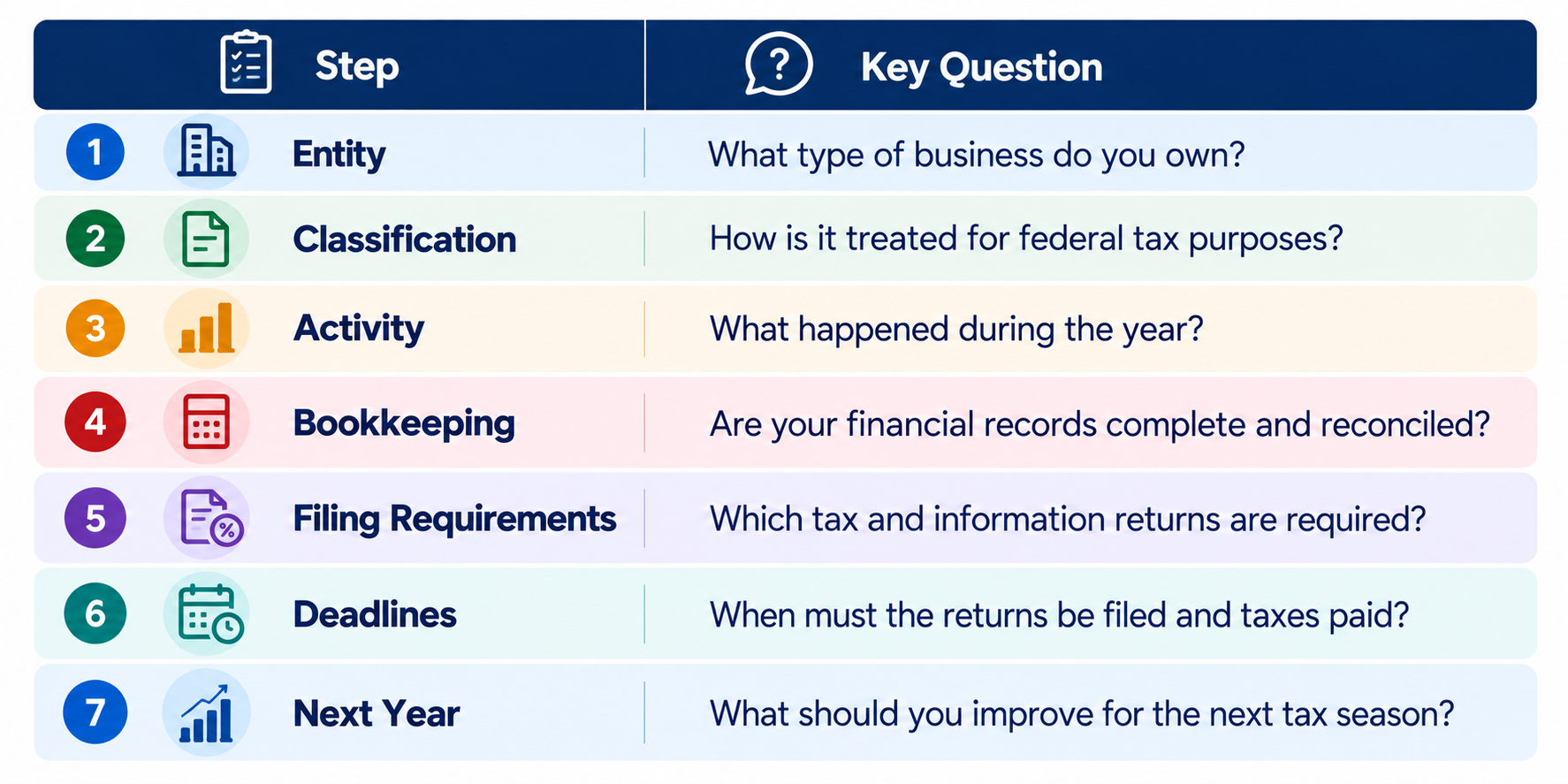
This framework helps you approach your first tax return as an organized business process rather than simply a filing deadline.
Make Your First Tax Return the Start of Better Financial Planning
Your first U.S. business tax return is an important milestone. But filing the return shouldn't be your only objective. The real goal is to understand your company's financial activity, meet applicable reporting obligations, and establish a reliable process for future tax years.
At InceptaBiz, we help international entrepreneurs navigate U.S. company formation, bookkeeping, tax preparation, compliance, and ongoing business operations.
Whether you're operating a single-member LLC, partnership, or corporation, understanding your filing requirements early can help you make better business decisions.
Your first tax return is about reporting the past. Good financial planning helps prepare your business for the future.
Frequently Asked Questions
Does every LLC file the same U.S. tax return?
No. Federal filing requirements depend on the LLC's tax classification, ownership, elections, and other circumstances.
Does a foreign-owned single-member LLC need to file Form 5472?
Certain foreign-owned U.S. disregarded entities must file Form 5472 with a pro forma Form 1120 when the applicable reporting requirements are met, including qualifying reportable transactions with related parties.
Do I need to file a tax return if my LLC made no money?
Possibly. Having no revenue or profit doesn't automatically eliminate tax filing or information-reporting obligations.
What is the difference between Form 1065 and Form 1120?
Form 1065 is generally used by partnerships, while Form 1120 is generally used by C corporations.
Are owner withdrawals deductible business expenses?
Owner withdrawals and distributions aren't automatically deductible business expenses. Their treatment depends on the business's tax classification and the nature of the transaction.
Can I request an extension for my first business tax return?
Depending on the return and applicable rules, an extension may be available. However, an extension to file doesn't necessarily extend the deadline to pay taxes.
What is the most important thing to prepare before tax season?
Accurate and organized bookkeeping records, including income, expenses, banking activity, and owner transactions, provide the foundation for preparing your tax return.